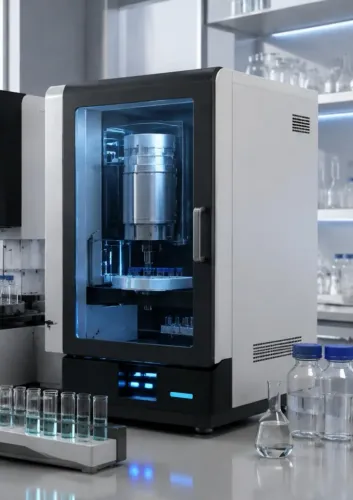


See how a laboratory can approach uninterrupted reagent delivery using coordinated syringe pumps and controlled flow parameters in Mumbai workflows.
A Continuous-Dosing Scenario for Mumbai Research Teams
Consider a laboratory process that requires a reagent to be introduced continuously over an extended period. The required flow is modest, but interruptions during syringe changes could influence mixing or the timing of the process.
A conventional syringe pump can deliver the reagent until its syringe reaches the end of its programmed volume. The operator then needs to refill or replace the syringe before delivery resumes. For some applications, that pause is acceptable. For others, it introduces an unwanted interruption.
An Advanced Pumping Systems configuration offers another approach. Two programmable pumps can coordinate their operation so that one pump continues delivery while the other prepares for the next cycle. The transition can be managed through parameters such as refill rate, priming rate and overlap volume.
Imagine a research workflow in Mumbai where a reaction vessel receives a controlled reagent stream. The first pump begins infusion while the second syringe is prepared. Rather than waiting until the first syringe is completely exhausted, the system can coordinate the changeover according to the programmed operating sequence.
The benefit is not simply convenience. A smoother transition can reduce the difference between the intended flow profile and the actual process. Whether that difference matters depends entirely on the application.
The same architecture can also be adapted for other fluid-handling requirements. The supplied product information describes alternating operation as well as Chain Pumping Mode, where multiple programmable pumps can be connected for sequential dispensing.
However, the system still needs to be configured around the application. Syringe volume, tubing, fluid properties, required rate and pressure all influence the appropriate setup. A continuous-pumping arrangement should therefore be validated against the actual process rather than assumed to be necessary.
This scenario illustrates a wider principle in laboratory automation: equipment becomes more valuable when its timing and control capabilities are designed around the process itself.
For teams exploring uninterrupted dosing or fluid transfer in Mumbai, Septech Marketing LLP can discuss suitable pumping configurations.