
Choosing a fluid-transfer pump depends on more than maximum flow: pressure, pulsation, dosing accuracy, fluid compatibility, cleaning, and tubing life can change the result completely. By the end, you will be able to compare a PeriXus configuration with syringe, diaphragm, gear, piston, centrifugal, and pneumatic pumps against your actual process requirements.
Key takeaways
- Choose PeriXus when fluid isolation and gentle, low-contamination transfer matter.
- Compare pressure, flow range, tubing size, viscosity and chemical compatibility before buying.
- Treat tubing replacement and calibration as part of the pump’s operating cost.
- Use a diaphragm or gear pump when pressure, solvents or continuous duty exceed tubing limits.
How PeriXus Fluid Transfer Works and Where It Fits
A PeriXus peristaltic pump moves liquid by squeezing flexible tubing against a pump head. Rollers create a travelling occlusion: each closed section pushes a measured volume forward while the tubing behind it recovers and draws in more liquid. The fluid contacts only the selected tubing, not the motor, rollers, or pump housing.
PeriXus fluid transfer fits these jobs:
- Continuous movement of small or moderate liquid volumes, including feed, dosing, sampling, and solvent transfer.
- Sterile or cross-contamination-sensitive work where replacing the tubing is easier than cleaning a wetted chamber.
- Fluids that need gentle handling, reversible flow, or operation without seals and valves in the liquid path.
- Processes where tubing compatibility is controlled. Extractables, adsorption, gas permeability, sterilisation, solvent composition, temperature, and contact time still require review.
The operating principle also defines its limits. Compare the peristaltic pump versus other pump types by the job, not by a nominal flow figure.
| Method | Best fit | Main trade-off |
|---|---|---|
| Peristaltic | Tubing-only continuous transfer | Tubing fatigue and pulsation |
| Syringe | Precise finite-volume dosing | Refill interrupts flow |
| Diaphragm | Chemical isolation or gas handling | Wetted diaphragm, valves, and pulsation |
| Gear | Viscous liquid at higher pressure | Wetted clearances and greater shear |
| Centrifugal | High-volume circulation | Poor substitute for low-flow metering |
Calibrate flow with the actual tubing, liquid, temperature, and backpressure; rpm alone cannot predict delivered volume.
PeriXus Compared with Diaphragm, Syringe, Gear, Piston, Centrifugal, and Pneumatic Pumps
A PeriXus peristaltic pump compared with alternatives is strongest for clean, reversible, low-to-moderate flow transfer where tubing replacement matters more than maximum pressure. This laboratory pump comparison shows the practical trade-offs:
| Pump | Flow and pressure | Pulsation and dosing accuracy | Shear and viscosity | Priming and reversibility | Cleanability |
|---|---|---|---|---|---|
| PeriXus | Low-to-moderate flow; lower pressure than piston or gear pumps | Pulsating; accurate after calibration | Low shear; handles viscous fluids within its limit | Self-priming; reversible | Fluid contacts tubing only |
| Diaphragm | Moderate flow and pressure | Pulsating; moderate accuracy | Low shear; tolerates solids | Self-priming; reversible | Diaphragm and valves need cleaning |
| Syringe | Small, precise volumes; limited capacity | Very accurate, smooth delivery | Low shear; viscosity raises drive force | Must fill; reversible only with suitable drive | Syringe or disposable path is simple |
| Gear | Smooth flow; higher pressure | Good metering | More shear; strong viscous-fluid performance | Usually needs priming; reversible with suitable design | Gears, seals, and clearances are wetted |
| Piston | High pressure and accurate dosing | Low pulsation with multiple heads | More shear; good viscosity handling | Valve-dependent; reversible with suitable design | Wetted seals and valves complicate cleaning |
| Centrifugal | High circulation flow; low metering pressure | Resistance-dependent; poor low-flow dosing | Shear rises with speed; limited viscosity performance | Usually needs priming; reversal is uncommon | Wetted impeller and casing require cleaning |
| Pneumatic | Moderate flow and pressure | Pulsating; control-dependent accuracy | Low-to-moderate shear; handles solids | Self-priming; reversible by valve arrangement | Wetted chamber needs cleaning |
A centrifugal pump suits circulation or bulk transfer, not precise dosing: viscosity and system resistance change its output. For HPLC, compare pressure, inlet pulsation, solvent compatibility, degassing, and high-pressure suitability—not free-flow claims alone.
The PeriXus Specifications That Decide Whether the Comparison Is Meaningful
A valid PeriXus pump comparison starts with the exact pump-head, tubing, and controller configuration—not the product name alone. Record the supplier-verified values before comparing alternatives:
| Specification | Confirm for the selected configuration |
|---|---|
| Flow range and pressure | Measured flow range at the intended tubing; maximum operating pressure, not free-flow output |
| Tubing | Inner diameters, wall thickness options, and compatible silicone, PharMed, Tygon, Norprene, or fluoropolymer grades |
| Control | Motor-speed range, analogue or digital speed control, pulse input, feedback, and reversible operation |
| Fluid limits | Allowable fluid-temperature range and maximum viscosity in centipoise |
Do not substitute free-flow rate for usable capacity. Backpressure changes tubing deformation, slip, heat, and delivered volume, while motor speed only describes rotation; neither predicts accuracy at the outlet. Request measured accuracy and repeatability at low, nominal, and high setpoints with the selected tubing.
For a meaningful laboratory pump comparison, include fresh tubing and tubing near its stated life limit. That exposes drift before it becomes a process failure.
Analytical and preparative HPLC users need a separate check. Confirm pressure margin, pulsation at the detector or column inlet, solvent compatibility, degassing requirements, and flow accuracy across the method. Establish whether the PeriXus configuration serves low-pressure sample or fraction transfer; do not assume it is suitable for high-pressure mobile-phase delivery.
Without those checks, a perixus pump comparison measures catalogue numbers, not performance.
Tubing Life, Calibration, and Pulsation: The Variables That Change Delivered Flow
Tube selection and compression determine both metering accuracy and service life. Inner diameter sets displaced volume; wall thickness and elasticity control occlusion and bore recovery. Silicone suits flexible general laboratory transfer but has higher gas permeability and weaker resistance to some organic solvents. Fluoropolymer offers stronger chemical resistance but can fatigue sooner under repeated flexing.
Select compatible materials by solvent, temperature, sterilisation method, extractables, adsorption, gas permeability, and fluid contact time.
Incomplete occlusion permits backflow and reduces delivered volume. Excessive occlusion raises heat, drive load, tubing wear, and fatigue while slowing bore recovery; flow then drifts even at constant motor speed. Replace tubing at the validated cycle or hour limit for that material and head, not on a universal calendar, and record failures.
A PeriXus pump comparison is incomplete without this interval.
Calibrate PeriXus fluid transfer at low, nominal, and high setpoints, using fresh tubing and tubing near its stated life limit. Measure delivered mass or volume under actual backpressure and compare accuracy and repeatability.
Pulsation control involves these trade-offs:
| Control | Benefit | Cost or risk |
|---|---|---|
| More rollers | Smaller flow pulses | Higher compression and wear |
| Head geometry | Smoother overlap | Less compatible tubing choices |
| Lower motor speed | Lower pulse frequency and shear | Reduced throughput |
| Tube selection | Changes compliance and pulse size | Alters chemistry and fatigue life |
| Pulse dampener | Smooths downstream flow | Adds residence volume and cleaning burden |
| Downstream control | Stabilises a process inlet | Adds pressure drop and dead volume |
A Practical Buying Checklist for PeriXus Fluid Transfer
Ask for evidence at your conditions, not a catalogue maximum. For a PeriXus peristaltic pump compared with alternatives, request a trial using the actual liquid, tubing, temperature and backpressure; treat peristaltic pump versus other pump types as a process decision.
1. Request measured accuracy and repeatability at low, nominal and high setpoints, with fresh tubing and tubing near its stated life limit.
2. Confirm maximum operating pressure, continuous pressure at your setpoint and the remaining pressure margin. Free-flow rate alone proves little.
3. Ask how the pump primes, recovers after an empty inlet, and tolerates dry running. A dry tube can overheat, flatten or lose calibration.
4. Verify reverse operation, restart behaviour and air handling. Ask whether trapped bubbles cause missed volume, foaming or sensor faults.
5. Require tubing replacement records showing material, lot, installation date, operating hours, sterilisation cycles and observed drift.
6. Obtain the sterilisation and changeover procedure, including wetting, flushing, pressure release and verification before the next batch.
7. Define whether operators clean the fluid path or replace it. For disposable paths, assess tubing, connectors, additives, sterilisation, solvent, contact time and temperature for extractables, leachables and adsorption.
8. Price drift and downtime: include recalibration, failed samples, tubing, labour, recovery time and lost production.
Septech Marketing LLP can match these results to laboratory pumping, sample-handling and automation equipment, rather than treating the pump name as the specification.
Related products
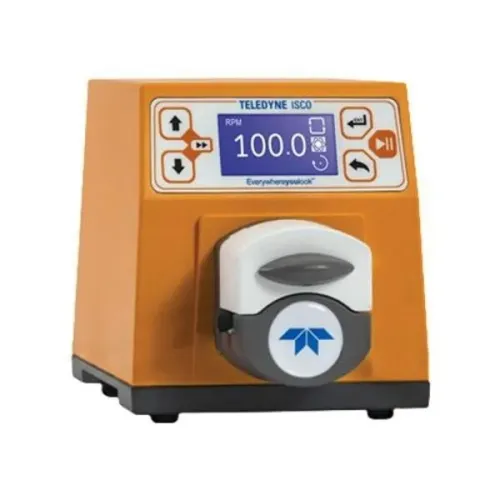
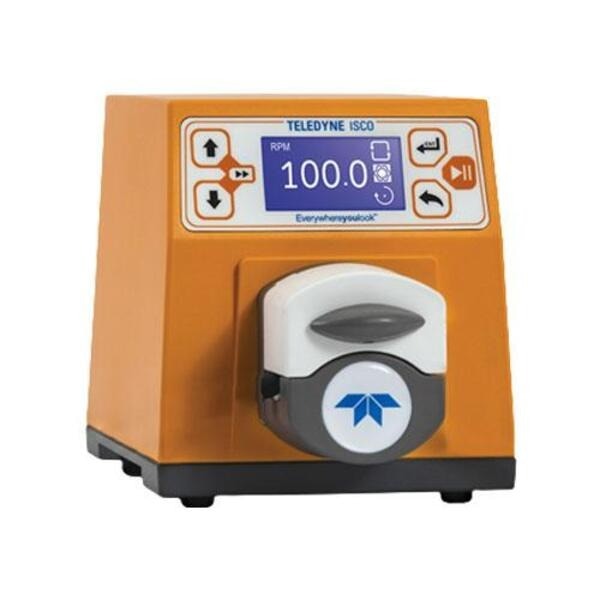
 | Pumps The Teledyne ISCO PeriXus Peristaltic Pump is designed for both laboratory use and continuous processing applications. View product → |
 | Longer Peristaltic Pump BT600-2J Mid-to-High-Flow Range Peristaltic Pump The BT600-2J is a mid-to-high-flow peristaltic pump designed for laboratory and industrial fluid transfer applications. View product → |
Frequently asked questions
How does PeriXus fluid transfer work?
Rollers compress flexible tubing against the pump head, creating a travelling occlusion that moves liquid forward. The liquid contacts only the tubing.
How does a PeriXus peristaltic pump compare with a diaphragm pump?
PeriXus isolates the fluid in tubing and supports quick cleaning through tubing replacement. A diaphragm pump handles higher pressure in many applications but exposes the fluid to valves and a diaphragm.
Which specifications make a PeriXus pump comparison meaningful?
Compare required flow rate, pressure or lift, tubing material and bore, liquid viscosity, chemical compatibility, temperature, duty cycle and acceptable pulsation.
What affects delivered flow from a PeriXus pump?
Tubing bore, wall thickness, elasticity, roller speed, tubing wear, back pressure and calibration all affect actual flow. Measure output under operating conditions.
When is a PeriXus peristaltic pump the wrong choice?
Choose another pump when the process needs high pressure, very low pulsation, abrasive-fluid durability, long continuous service without tubing changes, or compatibility beyond available tubing materials.
Related products
 | Longer Peristaltic Pump GM100-2A&WX10 Mini Peristaltic Pump The GM100-2A & WX10 is a compact mini peristaltic pump designed for laboratory and small-scale industrial applications requiring precise fluid... |
 | Longer Peristaltic Pump BT300-2J Mid-Flow Range Peristaltic Pump The BT300-2J Mid-Flow Range Peristaltic Pump is widely used in laboratory applications for reliable and precise liquid transfer. View product → |
 | Longer Peristaltic Pump BT100-3J Basic Peristaltic Pump The BT100-3J is a precise peristaltic pump designed for laboratory, pharmaceutical, and industrial applications requiring low-to-mid flow rates. View product → |
 | New Era Programmable Peristaltic Pumps 9000 Series The 9000 Series Programmable Peristaltic Pumps are designed for precision fluid handling, making them ideal for applications ranging from small-scale... View product → |