
A Purion run does not begin with a vial being placed directly inside the mass spectrometer: the sample enters a chromatography stream, separates on a column, and reaches the detector through a controlled post-column split. By following each transfer, ionisation, mass-selection and collection step, you can set up a reliable run and explain why a detected peak did—or did not—produce the expected fraction.
Key takeaways
- LC separation determines when each compound reaches the mass spectrometer.
- Confirm the target ion’s m/z before assigning a fraction trigger.
- Monitor spray, pressure, retention time, and signal during the run.
- Review method settings, calibration, solvents, and collection limits before injection.
From LC injection to a measured m/z signal
Understanding how a PurIon mass spectrometer works from injection to result starts with the LC injection, not the sample vial itself. An autosampler or manual injector places the sample into the mobile-phase stream, which carries it through the preparative column. The separated compounds leave the column at different retention times.
- The post-column flow splits: a small stream enters the mass spectrometer, while the larger preparative stream continues toward the fraction collector.
- In electrospray, the MS stream becomes charged droplets. Solvent evaporates, leaving gas-phase ions whose formation depends on solvent composition, additives, source temperature and spray stability.
- The mass analyser separates ions by mass-to-charge ratio, or m/z. The detector converts arriving ions into an electrical signal.
- Software processes signal intensity against retention time and displays a chromatogram. A selected m/z trace or defined m/z window identifies the target more reliably than a total-ion chromatogram alone.
- The fraction collector acts later because the preparative liquid must travel from the split point to the collection needle. A measured or calculated fraction delay shifts the collection window so the detected peak reaches the correct vial.
This PurIon mass spectrometer workflow produces a displayed signal before collection finishes. The signal indicates that ions with the selected m/z reached the detector; it does not prove that the target is pure.
Use retention time, peak shape, intensity threshold and collection timing together, because an in-source fragment or co-eluting compound can share the same nominal m/z.
Preparing the sample and identifying the target ion
Prepare a clean, soluble aliquot at a concentration that will not overload the preparative column or detector.
For PurIon mass spectrometer sample analysis, match the injection solvent to the starting mobile phase closely enough to avoid precipitation or peak distortion, and use volatile additives such as formic acid or ammonium acetate when the method requires them.
- Filter the sample through a solvent-compatible 0.2 or 0.45 µm membrane before loading it.
- Remove, dilute, or exchange samples containing high salt, phosphate, detergents, or other nonvolatile buffers; these materials suppress ionisation and contaminate the source.
- Run a solvent blank after a concentrated or sticky sample. Carryover can create a false target peak in the next injection.
- Establish polarity, mass range, additive conditions, and detection threshold with an authentic standard or a known sample.
- Select the strongest clean ion that is specific to the compound, such as the expected protonated or deprotonated molecule, and collect on that m/z or a narrow validated window rather than on total-ion current.
Detector choice changes the evidence you get:
| Detector | Strength | Limitation |
|---|---|---|
| UV | Stable peak shape and load information for chromophoric compounds | Misses compounds with little or no UV absorbance |
| MS | Detects many non-UV-absorbing compounds and supplies m/z evidence | Ion suppression and matrix effects can weaken or remove the signal |
Use matching retention time and supporting traces to confirm identity. Agreement between UV and MS strengthens the assignment, but disagreement alone does not prove either detector is faulty.
Turning a mass signal into a collected fraction
An m/z peak triggers collection only after the system accounts for the liquid’s travel time. In the PurIon mass spectrometer workflow, the post-column stream is split: a small flow reaches the mass spectrometer, while the larger preparative flow continues toward the fraction collector.
The instrument detects the compound in the split stream, applies the measured or calculated fraction delay, and signals the collection valve when that compound reaches the needle.
A mass directed fractionation workflow normally combines the selected ion with collection rules:
- A defined m/z or m/z window, rather than the total-ion signal alone
- A minimum signal threshold to reject baseline noise
- A retention-time or peak-shape condition to confirm the expected elution region
- Minimum and maximum collection times
- A post-peak collection period to capture the trailing edge
The delay is the critical link. If the delay is too short, the target enters the preceding vial; if it is too long, it enters the following vial, even though the displayed mass trace is correct.
Using m/z alone also risks collecting unrelated co-eluting material, an in-source fragment, or another compound with the same nominal ion.
The run record connects each vial to the event that caused collection: retention time, polarity, selected ion or mass range, signal intensity or area, fraction number, collection time, and any UV trace. Check these records against the delay and chromatogram before accepting a target-containing fraction.
Running, monitoring and troubleshooting a PurIon method
Start PurIon mass spectrometer operation with a verified method, stable solvent flow and a clean source, then follow the run in this order:
- Load the prepared sample, check the autosampler position, and inject it into the LC stream.
- Watch the preparative chromatogram as the column separates the sample; the detector receives the eluting peak only after it leaves the column.
- Monitor UV and MS traces together. Use the selected m/z or defined m/z window, retention-time rule, signal threshold and peak-shape rule to trigger collection.
- Confirm that minimum and maximum collection times, post-peak delay and fraction-vial assignment match the method.
- Record retention time, polarity, m/z, intensity or area, collection time, fraction number and any UV trace.
For PurIon mass spectrometer sample analysis, investigate a missing signal in sequence: confirm the injection occurred, verify solvent flow and polarity, inspect spray stability, and check that the scan range includes the expected ion.
A weak signal can result from low concentration, ion suppression, unsuitable additives, source contamination or unstable nebulisation; compare the UV trace before changing the method.
An ambiguous result needs separation from interpretation. Check whether the peak is a total-ion response, a target m/z, an in-source fragment or a co-eluting compound. If UV and MS disagree, review peak shape, retention time and matrix effects rather than assuming either detector is faulty.
Examine the collected fraction record to prove which signal triggered the vial.
What the final result contains and what to confirm before a run
A defensible result links the detected ion to the collected vial, not merely to an m/z value. In how PurIon mass spectrometer works from injection to result, retain the chromatogram, polarity, selected m/z or mass window, intensity or area, retention time, fraction number, collection time, and UV trace.
- Confirm the target ion: [M+H]+, [M+Na]+, [M−H]−, or a solvent adduct—not just the neutral molecular weight.
- Verify the fraction delay from the post-column split to the collection needle. A wrong delay can place a correctly detected compound in the next or previous vial.
- Record the threshold, scan range, acquisition settings, flow split, and trigger logic used for collection.
- Check that the solvent and additive conditions produce ionisation; a UV peak without an MS trigger indicates a detection problem, not proof of absence.
- Before PurIon mass spectrometer operation, ask Septech Marketing LLP to identify the applicable PurIon integration document and confirm these settings against it.
| Record | What it proves | What it cannot prove |
|---|---|---|
| MS trace with m/z | The selected ion reached the detector | Full molecular structure |
| Retention time and UV trace | The signal aligns with an LC peak | That the peak contains only the target |
| Fraction number and collection time | Which vial received the triggered event | Correct collection if delay was wrong |
| Intensity or area | Signal strength or relative response | Purity or recovered mass without further testing |
Related product
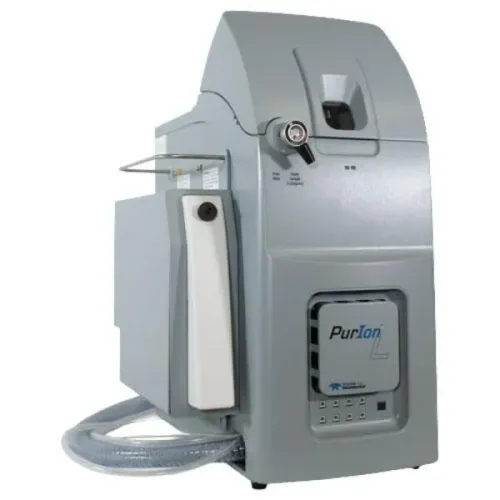
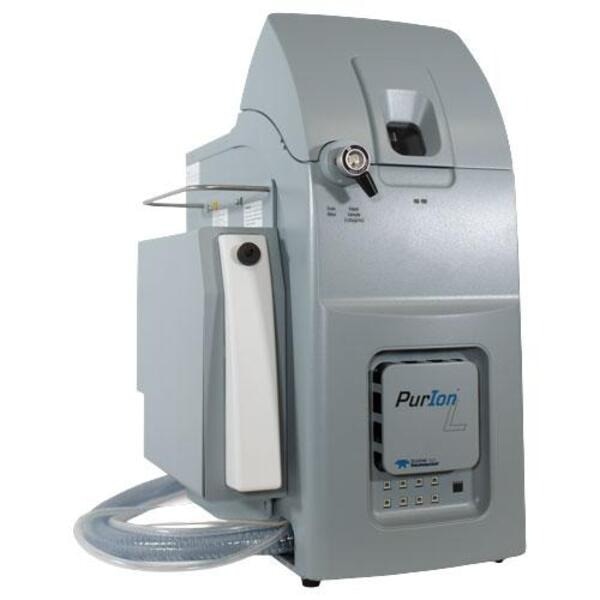
 | Chromatography The PurIon™ Mass Spectrometer is a compact, affordable, single-quadrupole mass analyzer designed for mass-directed fractionation in flash and... View product → |
Frequently asked questions
How does a PurIon mass spectrometer process a sample from injection to result?
An injector sends the sample through the LC column, separated compounds enter the ion source, and the detector records their mass-to-charge ratios as m/z signals.
How do you identify the target ion before running a PurIon method?
Use the expected molecular mass, charge state, adducts, and isotope pattern to select the target m/z and confirm it with a suitable standard or prior spectrum.
How does mass-directed fractionation turn a mass signal into a collected fraction?
The control method links a detected m/z signal and retention-time window to a valve or collector, directing the matching eluent into a designated vessel.
What should you monitor when running and troubleshooting a PurIon method?
Check LC pressure, solvent flow, spray stability, source response, retention time, target-ion intensity, and the timing of the fraction-collection valve.
What should you confirm before starting a PurIon sample analysis run?
Confirm solvent composition, flow rate, column condition, calibration status, target m/z, trigger thresholds, collection limits, vial positions, and waste capacity.