
An air-operated valve does not measure liquid flow by itself: it switches, isolates, or diverts a liquid path while a pump, pressure source, or metering device sets the volume. By the end, you will be able to trace a pharmaceutical sample from vial to detector, calculate a workable flow rate and residence time, and identify the controls needed for reliable results.
Key takeaways
- Use a separate metering device to set liquid flow; compressed air actuates the valve.
- Calculate residence time from tubing volume and actual liquid flow rate.
- Flush between samples and verify bubble removal to limit carryover and unstable results.
- Qualify wetted materials, dead volume, alarm responses, and cleaning procedures before use.
What “air valve continuous flow” means in a pharmaceutical system
Compressed air is the actuator, not automatically the liquid metering source. In air valve continuous flow systems pharmaceutical laboratories use, air pressure moves a diaphragm or piston to start, stop, divert, or isolate liquid. A separate pump, pressure regulator, syringe, calibrated tubing volume, or other displacement device sets the liquid flow.
These systems operate in three distinct regimes:
- Steady single-phase flow carries an uninterrupted liquid stream through the selected path. It suits stable delivery to a detector or reaction zone but requires careful bubble removal.
- Air-segmented flow alternates gas and liquid slugs. Deliberate segmentation can improve axial mixing and separate adjacent samples, while uncontrolled bubbles cause pressure oscillation, lost liquid volume, and detector noise.
- Programmed flow-through sampling switches between sample, reagent, rinse, and waste. This arrangement supports automated dilution, reaction sequences, and repeatable wash cycles.
For air valve flow sample processing, actuator pressure is not a flow-accuracy specification. Changing pump displacement, tubing bore, valve timing, or trapped volume can change delivered sample volume while air pressure stays constant.
Specify the valve type, liquid-metering principle, wetted materials, operating pressure range, and whether process air contacts the sample. If it does, control that air for particles, oil, moisture, and microbial contamination; air isolated behind a diaphragm presents a different qualification requirement.
How the sample travels from vial to detector and waste
A vial or reservoir feeds a pickup line, while a pump or metering loop sets the liquid volume. Pneumatically actuated valves select sample, dilution solvent, derivatisation reagent, wash solution, or waste; they do not alone determine flow accuracy.
This air valve flow sample processing path supports online dilution, liquid-liquid extraction, dissolution sampling, reaction monitoring, and continuous sample transfer.
- Pickup line: draws sample into the loop or pump.
- Valve and loop: loads, isolates, or diverts a measured plug.
- Reagent junction: combines sample with solvent or derivatisation reagent.
- Mixer and reaction coil: create uniform composition and residence time.
- Filter or temperature-controlled zone: removes particles or stabilises reaction conditions.
- Detector inlet: receives the treated stream; the outlet leads to a waste vessel.
A continuous flow pharmaceutical laboratory process can use three regimes:
| Regime | Mixing and dispersion | Bubbles, contact, and carryover | Detector fit |
|---|---|---|---|
| Steady single-phase | Smooth delivery, but long tubing, tees, wide-bore sections, and dead legs broaden concentration fronts | Greater wall contact; residual liquid in valve cavities and connectors can carry over | Suitable for detectors that require bubble-free liquid |
| Segmented flow | Gas slugs improve axial mixing and separate samples | Less wall contact, but uncontrolled bubbles cause noise, cavitation, and lost volume | Requires bubble management before UV, optical, or mass-spectrometric detection |
| Programmed switching | Valves sequence sample, reagent, wash, and waste; switching delays widen transitions | Wash reduces carryover but cannot erase dead volumes | Works when transient fronts are discarded before detection |
How to set sample volume, flow rate, timing, and residence time
A 100 µL sample loop defines the dose; the air-actuated valve only selects or diverts it. In a continuous flow pharmaceutical laboratory process, sample volume comes from loop volume, calibrated tubing, timed valve opening, or pump displacement—not pneumatic pressure.
1. Load the loop from the vial, then switch the valve to the reagent line. Pump sample and reagent through a mixer and reaction coil; discard the transient front until the composition stabilises, send the stable segment to the detector, then switch to wash and waste.
2. Set sample flow from the required dose and analysis frequency: Qsample = Vs × f. For 0.100 mL every 2 minutes, Qsample = 0.050 mL/min. Set total flow at or above the detector uptake rate and above Vcoil ÷ treaction; otherwise the reaction is incomplete or the detector starves.
3. Calculate tubing volume with Vtube = πd²L/4. A 0.50 mm internal diameter tube, 1 m long, holds about 0.196 mL. Residence time is tR = Vswept ÷ Qactual, so a 0.50 mL swept volume at 1.0 mL/min gives 30 seconds.
4. Add switching delay and equilibration volume to the discard volume: Vdiscard = Qactual × tswitch plus the volume needed for a stable response. Longer loops, wider tubing, valve cavities, tees, and dead legs increase dispersion; changing bore changes volume with the square of diameter.
This sizing explains how air valve continuous flow for systems process pharmaceutical samples without confusing actuator pressure with metering. Verify timing at the detector, not only at the valve.
How to control bubbles, carryover, particulates, and unstable results
Deliberate air slugs can improve axial mixing, reduce wall contact, and separate adjacent samples; uncontrolled gas does the opposite. In air valve continuous flow systems pharmaceutical operators must prevent bubbles from causing pump cavitation, incomplete loop filling, pressure oscillation, detector noise, and lost liquid volume.
Use a bubble trap upstream of the detector, then match gas control to the interface. UV and optical cells need a bubble-free, stable liquid stream because a passing bubble changes the optical path and produces spikes. Mass-spectrometric interfaces need controlled degassing and a stable liquid load; excess gas can disrupt nebulisation and spray stability.
Do not assume segmentation suits every detector.
- Run a high-concentration sample, followed by blank or wash injections, and measure the detector response at the assay wavelength or mass transition. Repeat after the specified wash sequence; a clear outlet does not prove acceptable carryover.
- Check recovery at low, nominal, and high concentration, then verify dilution linearity. Include valve cavities, loop ends, tees, connectors, and tubing in the assessment.
- Inspect narrow valve orifices and tubing for precipitated drug or excipient blockage. Pre-filtration protects restrictions but can adsorb analyte, reduce recovery, or act as a concentration-changing reservoir.
- Confirm whether the process uses steady liquid, air-segmented flow, or programmed sample–reagent–wash–waste switching. Continuous dissolution flow is not automatically equivalent to a batch compendial test; compare sampling, mixing, temperature, and timing against the named method.
In air valve flow sample processing, validate filtration, dilution, agitation, and temperature with the actual formulation, not its clear appearance.
What to specify and qualify before using the system for pharmaceutical samples
Set the specification before requesting a quotation. For an air valve continuous flow systems pharmaceutical application, document solvent, pH, temperature, pressure, viscosity, particulates, proteins, surfactants, tubing and valve materials, and air quality. State whether compressed air contacts the liquid or only actuates the valve.
1. Define the metering basis: pump displacement, sample-loop volume, calibrated tubing volume, or timed switching. Record target flow, sample volume, residence time, and allowable variation. Pneumatic pressure alone does not establish liquid-flow accuracy.
2. Qualify the complete wetted path, not the pump alone. Measure flow-rate accuracy and precision, delivered volume, valve timing, pressure stability, leak detection, and valve-position confirmation.
Test a failed-open valve, which can mix sample with wash, and a failed-closed valve, which can produce a misleading low or zero result; require an alarm or an independent flow, pressure, position, or recovery check.
3. Challenge performance with carryover, sample recovery, dilution linearity, and analyte stability across the full residence time. Validate cleaning using the complete solvent and reagent sequence, including standards, surfactants, proteins, immiscible solvents, and precipitating solvent changes; a clear outlet proves nothing about residue.
For a continuous flow pharmaceutical laboratory process, compare pump, valve, sample-handling, and automation components against this specification. Septech Marketing LLP can be included alongside other laboratory-equipment suppliers, rather than selected from a catalogue label alone.
Related products
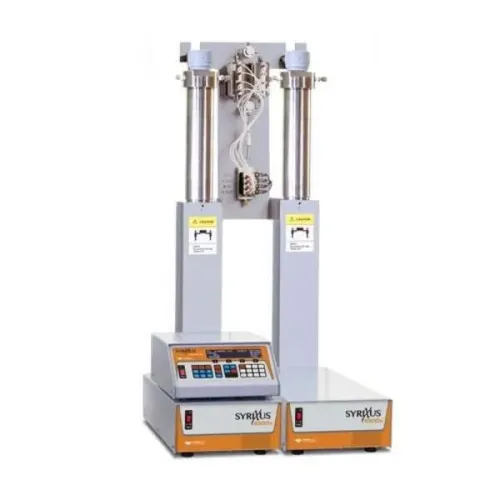
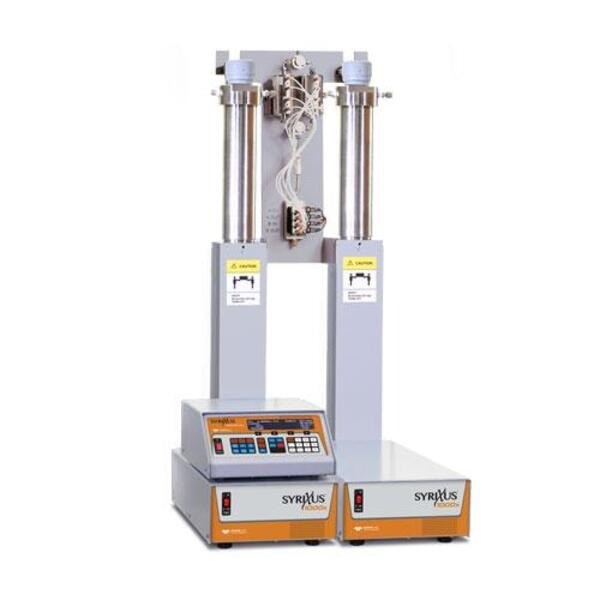
 | Pumps Dual-Pump Continuous Flow Systems Teledyne ISCO SyriXus dual-pump continuous-flow systems are designed to deliver a smooth, uninterrupted flow of fluid for demanding laboratory and... View product → |
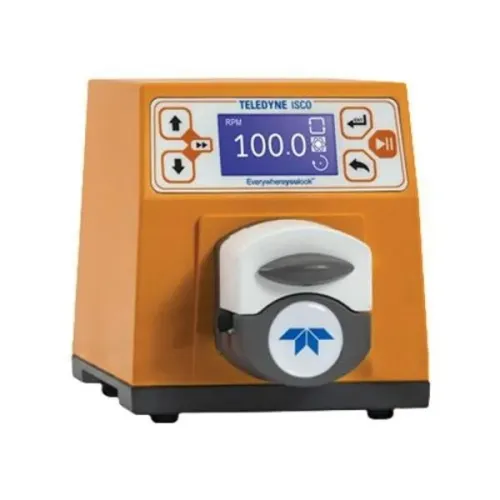
 | New Era Advanced pumping systems are designed to deliver smooth, continuous, and highly reliable fluid transfer by eliminating the flow rate pauses and... View product → |
Frequently asked questions
Does compressed air directly control liquid flow in an air valve system?
Not automatically. Compressed air actuates a diaphragm or piston, while a pump, regulator, syringe, calibrated tubing volume, or another displacement device meters the liquid.
How do you calculate sample residence time?
Divide the wetted internal volume between the injection point and detector by the actual liquid flow rate. Include valve cavities, connectors, and tubing when they hold sample.
How can you reduce bubbles and carryover?
Degas compatible liquids, keep connections leak-free, orient and prime the flow path correctly, flush between samples, and confirm bubble removal before measurement.
What should you qualify before processing pharmaceutical samples?
Document wetted materials, flow and volume accuracy, dead volume, pressure limits, leak testing, cleaning, carryover, particulate control, alarms, and data records.