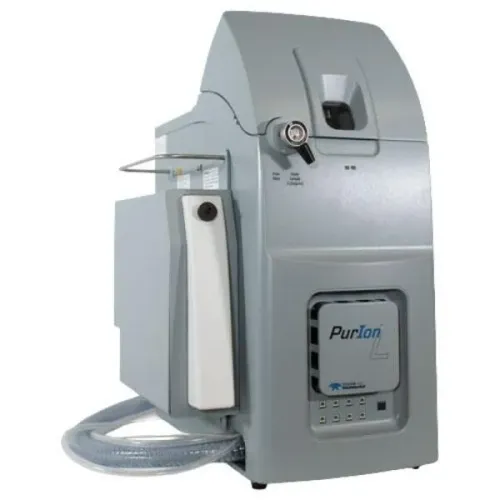

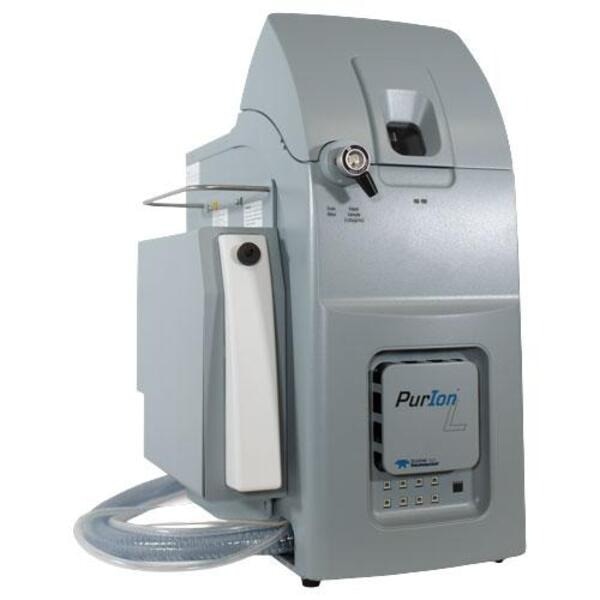
A PurIon system could help investigate some organic contaminants in prepared water extracts, but its stated role in mass-directed fractionation does not establish suitability for environmental compliance. By the end, you will be able to match each contaminant class to the correct analytical technique and identify the validation evidence required before purchasing or reporting results.
Key takeaways
- Start by confirming the contaminant is suitable for LC-MS analysis.
- Trace every sample-transfer, filtration, extraction, and storage step.
- Match the instrument output to the required reporting method.
- Test matrix effects before relying on water-testing results.
Start with the contaminant, not the mass spectrometer
Pesticides, pharmaceuticals, selected PFAS, some hydrocarbons, and non-volatile disinfection by-products could be investigated with a PurIon after an appropriate LC-MS workflow. A PurIon mass spectrometer for water testing is plausible when the target is an organic molecule that liquid chromatography can separate and an ionisation interface can convert into detectable ions.
The analyte, matrix, detection limit, and validated method determine suitability.
| Contaminant class | PurIon plausibility | Usual alternative or limitation |
|---|---|---|
| Pesticides and pharmaceuticals | Often suitable after LC separation and ionisation | Confirm selectivity and sensitivity in the water matrix |
| Selected PFAS | Possible with LC-MS; selected applications need LC-MS/MS | EPA methods require defined transitions and validation |
| Some hydrocarbons and non-volatile disinfection by-products | Possible when LC-compatible and ionisable | Many hydrocarbons are better suited to GC-MS |
| Lead, arsenic, mercury, cadmium, chromium, uranium | Not a conventional molecular-MS application | Use ICP-MS or ICP-OES |
| Major anions | Generally unsuitable | Use ion chromatography |
| Volatile organic compounds | Usually unsuitable for LC-MS | Use purge-and-trap GC-MS |
A conventional single-quadrupole molecular MS is not an ICP-MS substitute for dissolved metals. Nor does the PurIon name alone prove suitability for any contaminant class. Treat any claim of mass spectrometer environmental testing as a starting point: verify the analyser, LC connection, ionisation system, and validated performance for the named contaminant and matrix.
Map the complete water sample path
PurIon analytical suitability depends on a controlled sample path, not on putting water straight into the source.
1. Collect the sample in containers compatible with the target compounds, record the location and time, and preserve it according to the method. Chilling to about 4°C, protecting light-sensitive analytes in amber glass, acidifying, or adding dechlorinating reagent applies only when the method specifies it.
2. Remove suspended solids with a validated filter, then dilute a clean sample or concentrate it when the reporting limit requires greater sensitivity. Record the filter material, pore size, final volume, and any recovery loss.
3. Use solid-phase extraction when trace organics require cleanup or preconcentration. Select the sorbent for the analyte class, wash away salts and matrix components, elute the targets, and exchange the solvent before injection.
4. Send the prepared extract through liquid chromatography. Direct injection of untreated water is usually poor design: salts, natural organic matter, surfactants, suspended solids, and treatment chemicals can suppress or enhance ionisation, contaminate the source, destabilise the spray, increase carryover, and cause response drift.
5. Ionise the separated compounds, commonly by electrospray, and measure their mass-to-charge ratios with the configured analyser. A PurIon mass spectrometer for water testing therefore needs compatible LC and ionisation hardware.
6. Match preparation to the matrix. Clean drinking water may need modest treatment; wastewater, groundwater, seawater, and polluted process water demand matrix-specific cleanup and often preconcentration. Add isotope-labelled internal standards when quantitative work must correct for extraction loss, injection variation, ion suppression, and instrument drift.
Match the instrument to the reporting method
Defensible environmental data depend on the complete method, not the PurIon name or a quoted mass range. For purion analytical suitability, verify the exact analyser configuration, ionisation interface, LC connection, polarity switching, mass range, resolution, mass accuracy, scan and acquisition modes, quantitative software, and data audit trail.
Request evidence for these performance measures in the intended water matrix:
- Method detection limit and reporting limit at the proposed reporting concentration
- Linear range, recovery, precision, selectivity, carryover, matrix effects, and calibration stability
- Application-specific validation against an established reference method, with QC acceptance criteria
Use the following distinction when assessing mass spectrometer environmental testing:
| Application | Required evidence or configuration | Defensible conclusion |
|---|---|---|
| Screening | LC-compatible separation, suitable ionisation, and reproducible response; results flagged as investigative | Useful for trend work or compound investigation |
| EPA Method 537.1 and Method 1633 PFAS | LC-MS/MS, isotope-labelled standards, defined transitions, required sensitivity, and matrix-specific QC | A single-stage instrument is not equivalent without demonstrated validation |
| EPA Method 200.8 metals | ICP-MS sample preparation, interference control, internal standards, calibration, and QC | A molecular MS is not an ICP-MS substitute |
EPA Method 537.1 covers drinking-water PFAS, while EPA Method 1633 covers broader environmental matrices. Do not report either method’s results from a single-stage system without validation. Prioritise detection and reporting limits, recovery, precision, selectivity, carryover, matrix effects, and calibration stability over generic resolution or mass-range claims.
Test the matrix before trusting the result
A clean-water standard does not prove purion analytical suitability. Demand a qualification sequence using the water you will actually report.
- Run reagent blanks and fortified blanks to expose contamination, false positives, and recovery failures before testing samples.
- Test raw water, wastewater, seawater, and concentrated extracts, as applicable. Add matrix spikes and duplicates to measure recovery and precision in each matrix, then use post-extraction spikes to separate extraction loss from ion suppression or enhancement.
- Request calibration curves across the intended reporting range, plus the method detection limit, quantitation limit, reporting limit, accuracy, precision, and acceptance criteria. Require calibration verification at the start and end of each sequence, with continuing calibration checks throughout it.
- Run carryover tests after the highest standard and dirtiest extract. Ask how quickly sensitivity falls, how often the source requires cleaning, and whether blank responses remain acceptable.
- Prefer tandem MS with selected-reaction monitoring or multiple-reaction monitoring for dirty matrices. Nominal mass alone can fail when co-eluting compounds share the same ions.
Ask for ion-suppression measurements and false-positive controls, not a mass-range claim. For mass spectrometer environmental testing in the field, verify temperature and humidity limits, power requirements, contamination control, chain of custody, calibration records, and exportable audit trails. Without representative matrix data, treat the system as a development or screening tool, not validated environmental instrumentation.
Make the purchasing decision: screening tool or validated method?
Treat a PurIon mass spectrometer for water testing as a screening or development instrument unless application-specific validation proves otherwise. It is a reasonable choice for selected organic compounds that are LC-compatible and ionise reliably, including targeted pesticides, pharmaceuticals, some PFAS, non-volatile disinfection by-products, and certain hydrocarbons.
The supplier must demonstrate sensitivity, selectivity, robustness, and a workable preparation method in the actual water matrix.
Use the following decision categories:
- Validated for a named method: documented calibration range, recovery, precision, detection and reporting limits, matrix effects, carryover, quality-control limits, and comparison with the required reference method.
- Suitable for a defined screening application: useful for application development, fraction-directed investigation, confirmation, or trend screening, with limits and target compounds stated in writing.
- Unsuitable for the intended analyte and matrix: the workflow cannot meet the required selectivity, sensitivity, robustness, or preparation demands.
Do not infer suitability for lead, arsenic, mercury, cadmium, chromium, uranium, other metals, volatile compounds, major anions, microbiological contaminants, or EPA compliance reporting. Those applications normally require ICP-MS, ICP-OES, purge-and-trap GC-MS, ion chromatography, or non-MS methods.
For PurIon analytical suitability, ask Septech Marketing LLP for the exact configuration, LC and ionisation arrangement, representative-matrix data, and validation records. Treat catalogue claims as a starting point, not proof of environmental performance.
Related product
 | Chromatography The PurIon™ Mass Spectrometer is a compact, affordable, single-quadrupole mass analyzer designed for mass-directed fractionation in flash and... View product → |
Frequently asked questions
Which water contaminants could a PurIon investigate?
Pesticides, pharmaceuticals, selected PFAS, some hydrocarbons, and non-volatile disinfection by-products could be investigated when LC-MS can separate and ionise them.
What should you map before using a PurIon for water testing?
Map the complete sample path, including collection, preservation, filtration, extraction, containers, transfers, injection, and waste handling.
How do you match a mass spectrometer to the reporting method?
Check whether the method requires qualitative identification, quantitative concentration, confirmation ions, detection limits, calibration ranges, or a validated regulatory format.
Why must you test the water matrix before trusting results?
Salts, organic matter, suspended solids, and co-extracted compounds can suppress or enhance ionisation and distort reported concentrations.
When is a PurIon a screening tool rather than a validated method?
Treat it as a screening tool when the workflow lacks validated recovery, precision, accuracy, selectivity, detection limits, and documented quality controls.