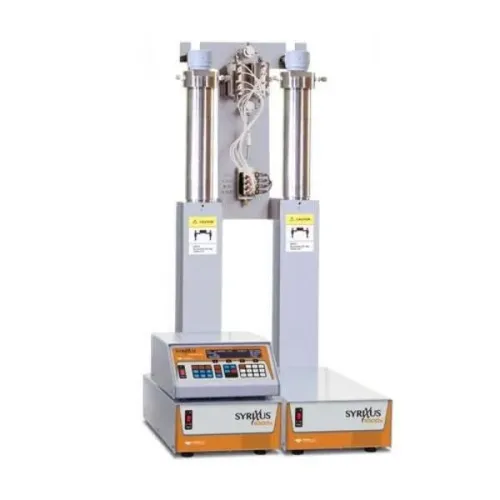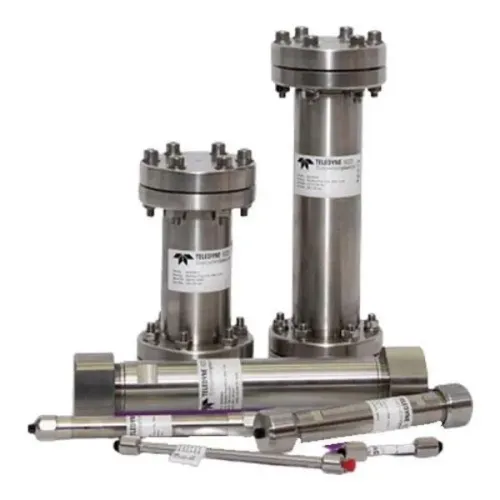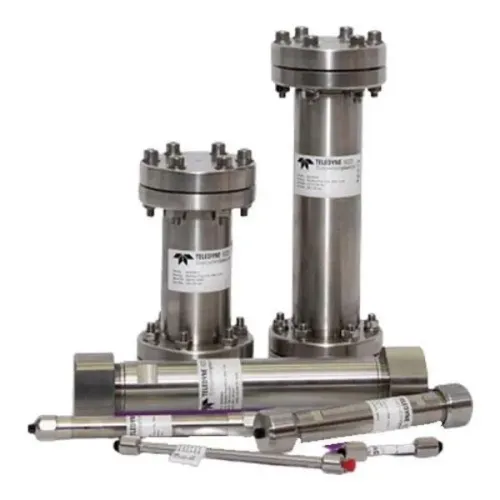

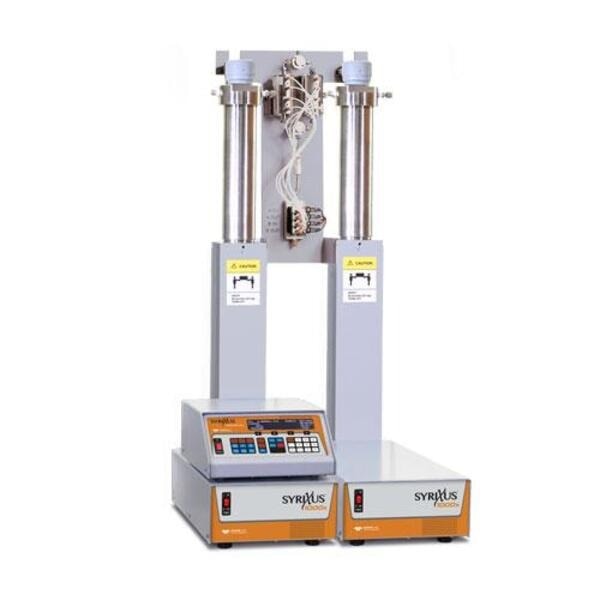
A quoted “dual pump package” can contain two pump modules and a controller yet leave out the tubing, reservoirs, valves, pressure control, or reactor hardware needed to run a process. By checking the inventory, sizing each channel against the real pressure and chemistry, and following a controlled startup sequence, you can distinguish a complete working system from a collection of pump modules.
Key takeaways
- Specify two independently controlled pump modules, not only a dual-head pump.
- Use separate channels for reactants, carrier fluid, or duty-and-standby delivery.
- Match pump materials, flow range, pressure rating, and control signals to the process.
- Test alarms, changeover, leak tightness, and uninterrupted flow before acceptance.
What equipment belongs in a dual pump continuous flow system package?
A buyer checking dual pump for continuous flow systems included equipment needs two independently controlled, compatible pump modules, not merely a dual-head pump. The practical minimum also includes:
- Drive or motor assemblies, controller, power supply, mounting hardware, and communication cables
- Two reservoirs, inlet filters, solvent-compatible inlet tubing, pump heads, fittings, and check valves
- A junction or mixer, reactor tubing or a packed-bed reactor, and temperature-control hardware
- Pressure sensors or a pressure-monitoring point, a back-pressure regulator, outlet tubing, and a receiver
A continuous flow system package often covers the pump modules, drives, controller, pump heads, and basic fittings. Confirm every line item rather than treating “package” as proof that the process is ready to run.
| Item | Commonly supplied | Frequently purchased separately |
|---|---|---|
| Pump hardware | Modules, motors, controller, cables, mounting parts | — |
| Fluid path | Pump heads, some fittings, basic tubing | Reservoirs, inlet filters, solvent-compatible tubing, check valves |
| Process section | — | Mixer, reactor coil or packed-bed reactor, heaters, temperature sensors |
| Pressure and collection | Sometimes a sensor or regulator | Pressure-relief device, back-pressure regulator, outlet tubing, receiver or collection vessel |
Before ordering, request a line-by-line packing list, wetted-materials schedule, spare-parts list, electrical requirements, and installation drawings. Check PTFE, PFA, PEEK, stainless steel, seals, frits, adhesives, and reactor packing against your chemicals and temperature. The supplier must identify pressure ratings across the complete wetted path.
How can two pump channels divide delivery duties?
A dual pump means two independently controlled metering channels, each with its own inlet line and pump head. Do not confuse this with one pump carrying two piston heads: that arrangement can still produce one blended or proportioned stream.
| Assignment | Channel arrangement | Practical purpose |
|---|---|---|
| Alternating delivery | One channel runs while the other takes over | Change reservoirs or pump heads without stopping the process |
| Continuous replenishment | Each channel draws from a separate reservoir | Maintain supply when one reservoir is being refilled |
| Independent reagent feeds | Each channel meters a different reagent into a mixer | Set stoichiometry before the combined stream enters the reactor |
| Redundant service | Both channels support the same fluid duty through a switching arrangement | Preserve critical fluid service after a pump fault |
Do not assume both channels need identical tubing, pump heads, fluids, flow rates, or settings. Confirm channel independence, permitted pump-head combinations, controller limits, and synchronisation functions in the model manual; an apparently flexible dual pump system may restrict these combinations.
In a dual pump continuous flow setup, place the mixer as close as practical to the reactor inlet. Long or unequal lines between the pumps and mixer add dead volume, so a recipe or flow adjustment reaches the reactor late and the composition changes gradually rather than immediately.
Check that the dual pump system components support the chosen assignment, including compatible wetted materials, pressure ratings, and control resolution. Redundant operation also requires defined changeover logic; two pumps connected to one line do not provide useful backup if a failed check valve blocks that line.
What is the correct dual pump continuous flow setup sequence?
Treat commissioning as a controlled progression from hardware inspection to a stable liquid run. Do not introduce reactive materials or heat until both channels deliver verified flow.
1. Unpack the dual pump continuous flow setup and inspect every module for damage. Record each pump, controller, and drive serial number against the packing list.
2. Mount the pumps and controller securely, then connect the communication cables and power supply. Confirm the controller recognises both pump channels before attaching process fluids.
3. Identify each inlet and outlet port from the labels or manual. Install chemically compatible tubing with the correct internal diameter, keeping every line fully seated, supported, and free of kinks.
4. Fit an inlet filter and check valve to each channel, then connect the correct reservoir to each inlet. Prime the pumps separately with the process-compatible liquid and remove gas from both inlet lines before joining the streams.
5. Arrange the outlet path as pump A and pump B, mixer or junction, reactor or packed bed, pressure sensor, back-pressure regulator, and receiver. Put the mixer as close as practical to the reactor inlet; unequal lines create dead volume and delayed composition changes.
6. Run both channels at low flow. Inspect every fitting for leaks, verify measured flow from each outlet, establish back pressure, and confirm that the pressure reading is credible.
7. Introduce reagents only after liquid flow is stable, then start heating. Never start a dry pump or send a gas slug into a packed bed or narrow reactor.
Record tubing internal diameter, reservoir identity, pump settings, pressure, temperature, and measured output during commissioning.
How should you size and specify both pumps for the actual process?
Maximum flow rate is a poor pump-selection basis: a pump that reaches the target rate may still fail against a viscous solvent, narrow tubing, or a packed bed. Specify each channel for stoichiometry, concentration, residence time, pressure drop, viscosity, temperature, flow range, pressure rating, tubing size, and chemical compatibility.
For solutions with concentrations C1 and C2 and a target molar ratio n1:n2, set Q1:Q2 to (n1/C1):(n2/C2). Equal volumetric flow is correct only when concentrations and required molar amounts match.
| Selection point | Incorrect assumption | Correct specification |
|---|---|---|
| Flow ratio | Both pumps run at the same rate | Calculate Q1 and Q2 from concentration and molar ratio |
| Residence time | Use only the reactor-coil volume | Use t = V/(Q1 + Q2) for total reaction-zone volume |
| Pressure | The pump’s maximum pressure is available at all flows | Request pressure-versus-flow data for the actual fluid and assembly |
Calculate V from the mixer, reactor, connecting lines, heat exchanger, and downstream hold-up volume. Request pressure-versus-flow data covering the actual solvent, tubing bore, filters, mixer, packed bed, reactor, and back-pressure regulator.
Check the complete wetted path in the continuous flow system package: PTFE, PFA, PEEK, stainless steel, seals, frits, adhesives, and reactor packing. Confirm the dual pump system components tolerate the chemicals and operating temperature, not merely the pump heads.
Ask whether the heater controls the reactor block, fluid inlet, or surrounding air. Record sensor location, usable temperature range, warm-up time, temperature uniformity, and behaviour after loss of flow.
How do you verify uninterrupted operation before buying or accepting the system?
Uninterrupted flow means the combined outlet keeps its specified rate and composition during faults, reservoir changes, and normal pressure variation—not merely that two motors run. Demand a written failure-response matrix, alarm logic, shutdown setpoints, pressure ratings, and recorded test results rather than a promise of “continuous” delivery.
1. Run each pump independently at the intended low, nominal, and maximum operating points. Record gravimetric flow accuracy, pulsation, flow-ratio accuracy, and check-valve seating. Ask whether pulse dampers, active pressure compensation, or a piston/cam profile suited to low flow controls oscillation, and request check-valve replacement intervals.
2. Test changeover, pressure changes, air bubbles, an empty reservoir, blocked tubing, and loss of flow. The controller should identify the fault, alarm, and enter a defined safe state without sending an uncontrolled slug downstream.
3. Leak-test the assembled wetted path at operating pressure, then measure pressure and temperature stability. A back-pressure regulator maintains liquid-phase pressure and reduces bubbles near a solvent’s boiling point; it does not replace pump pressure relief. Give every pump head, tube, fitting, reactor, sensor, and regulator an adequate pressure margin.
4. Measure residence time with a tracer or step change, and test shutdown for excess pressure and lost flow. Record acceptance limits and raw data.
When comparing a dual pump system supplier in Mumbai, ask Septech Marketing LLP to quote installation, commissioning, certificates, spare seals and check valves, compatibility review, Indian parts availability, service response, electrical requirements, and operator training separately. Also ask for the Dual Pump for Continuous Flow Systems Included Equipment packing list.
Related product
 | Pumps Dual-Pump Continuous Flow Systems Teledyne ISCO SyriXus dual-pump continuous-flow systems are designed to deliver a smooth, uninterrupted flow of fluid for demanding laboratory and... View product → |
Frequently asked questions
What equipment belongs in a dual pump continuous flow system package?
The package needs two independently controlled compatible pump modules, inlet reservoirs, tubing, fittings, check valves, pressure monitoring, flow control, a mixing or joining point, and safety features such as leak detection and alarms.
How can two pump channels divide delivery duties?
Assign each channel a separate reactant or solvent, combine both streams before the process, or configure one pump for duty and the other for standby. Confirm that the control system supports the selected operating mode.
What is the correct dual pump continuous flow setup sequence?
Inspect wetted materials, connect reservoirs and tubing, install filters and check valves, prime each channel separately, remove air, verify flow direction, combine the streams, test pressure, and run the process at operating conditions.
How should you size and specify both pumps for the actual process?
Specify each pump against its required flow range, maximum pressure, fluid viscosity, chemical compatibility, temperature, pulsation tolerance, accuracy, and control interface. Include startup, cleaning, and worst-case operating conditions.
How do you verify uninterrupted operation before buying or accepting the system?
Run both channels continuously at the target flow and pressure, test low-level and high-pressure alarms, simulate a blocked line and empty reservoir, check automatic changeover if included, and document flow stability, leaks, and recovery time.