
Fluid reaches the receiving vessel because rotating rollers close a flexible tube in sequence, carrying trapped volumes from the inlet to the outlet. By the end, you will be able to trace that path, install and prime the tube, set a defensible flow rate, and identify the conditions that cause delivery errors.
Key takeaways
- Rollers create flow by sealing and advancing discrete tubing volumes.
- Keep the inlet, pump head, and outlet tubing aligned to preserve the fluid path.
- Verify flow rate by collecting discharge for a measured time.
- Choose tubing against chemical compatibility, pressure, temperature, and contamination limits.
How the rollers carry liquid from inlet to outlet
The rollers create forward flow by squeezing flexible tubing against the pump housing. As the rotor turns, each roller forms a temporary seal, or occlusion, behind the trapped liquid; the sealed volume then travels from the inlet side toward the outlet.
A following roller repeats the displacement, while the tubing springs open behind it and draws in more liquid.
The complete peristaltic pump fluid path is:
- Source vessel or supply line
- Inlet connector and inlet tubing
- Tubing section seated in the PeriXus pump head
- Occluded tubing carried between the rotating rollers and housing
- Outlet tubing and outlet connector
- Receiving vessel or downstream process line
The pump head, rollers, and drive remain outside this wetted path. The selected tube, connectors, seals, filters, and any dead volume define what the liquid contacts, so a clean tube and secure fittings matter as much as the drive setting.
That is the practical answer to how perixus peristaltic pump for works: rotation moves sealed portions of liquid rather than pushing a piston through the fluid. Perixus peristaltic pump operation is not perfectly smooth; each roller creates a small flow and pressure pulse.
Trapped air magnifies that ripple and delays delivery, while a blocked outlet increases tubing deformation and can reduce actual flow.
A complete peristaltic pump fluid path therefore needs the inlet and outlet identified before starting. An incorrectly oriented tube, closed valve, loose connector, or unvented source can stop delivery even when the rotor is turning.
A PeriXus pump setup that preserves the fluid path
Seat the tubing correctly before the rotor turns. A PeriXus pump setup fails quickly when the tube does not match both the fluid chemistry and the pump-head geometry: an unsuitable tube can leak, slip, collapse, or remain inadequately occluded.
The selected tubing defines most of the fluid path. Connect the inlet to the source vessel and the outlet to the receiving vessel or process line, using compatible fittings, seals, and filters. Keep the inlet short and unrestricted; suction resistance can draw air into the line even while the pump rotates.
- Inspect the tube for cracks, flattening, contamination, or the wrong inner diameter and wall thickness. Confirm its chemical, temperature, and pressure limits.
- Open the pump head, place the tube in the correct channel, and seat it evenly without twisting. Ensure the tube follows the intended curve and is neither stretched nor pinched.
- Close and latch the head fully so the rollers provide consistent occlusion. Secure every connector and clamp, then check that the source vessel can vent.
- Verify inlet and outlet orientation, open the required valves, and provide a safe waste or receiving route.
- Prime the inlet line with the process fluid before setting the delivery rate. Air compresses and releases inside the tube, causing delayed flow, erratic filling, and apparent rate error.
- Start at low speed, watch every connection for leaks, and increase speed only after a continuous, bubble-free stream reaches the outlet.
Stop immediately for seepage, pulsing caused by trapped air, tube movement, or loss of prime. Fix the path before increasing speed.
Turning pump speed into a verified flow rate
Pump speed is only one input, not a guaranteed flow rate. Each roller pass displaces a volume set by the tubing’s internal diameter, wall elasticity, and compression in the pump head, so changing the tube changes the volume delivered per revolution. PeriXus peristaltic pump operation therefore needs a measured rate, not just an rpm setting.
- Tubing size: A larger internal diameter carries more liquid per revolution; a smaller bore reduces output.
- Viscosity: Thick fluid resists movement and can reduce actual flow, especially during startup and acceleration.
- Suction lift: Lifting liquid from a low vessel increases inlet resistance. Excessive lift can cause delayed filling, bubbles, or loss of prime.
- Backpressure: Narrow outlets, filters, valves, and long lines oppose flow. Rising resistance lowers delivery and increases tube stress.
- Wear: Repeated occlusion flattens and fatigues the tube, changing its internal shape and reducing displacement before cracking or rupturing.
- Pulsation: Rollers deliver discrete volume pulses, so a short collection can look high or low even when the average rate is correct.
Verify the rate by collecting the outlet for a measured time and weighing the liquid for gravimetric calibration, or measuring its volume. Use the intended tubing, fluid, temperature, speed, suction lift, and downstream resistance; record mass or volume against time.
Repeat the test after significant tubing wear, a process change, or a changed speed, then adjust the setting or replace the tube.
Choosing tubing for chemistry, pressure, temperature, and contamination control
Inner diameter controls the volume moved per roller cycle, while wall thickness controls how reliably the tube occludes and how much pressure it withstands. A larger bore increases capacity but also increases residual volume; a thinner wall can reduce compression life and make delivery unstable.
Compare candidate tubing against the actual fluid path, not the pump name alone.
| Criterion | Compare | What can go wrong |
|---|---|---|
| Inner diameter | Match the required flow range and connector bore | Excessive bore increases hold-up volume and slows flushing |
| Wall thickness | Confirm the pump head can fully occlude it | Incomplete occlusion causes backflow, air entry, and poor repeatability |
| Chemical compatibility | Check the tubing, liner, and seals against every solvent, reagent, and cleaning fluid | Swelling, embrittlement, extractables, or cracking can contaminate the sample |
| Temperature range | Include fluid temperature, room temperature, and cleaning temperature | Heat softens tubing, reduces pressure tolerance, and accelerates fatigue |
| Pressure rating | Compare the rating at your operating temperature with outlet backpressure | A blocked filter or closed valve can rupture the tube |
| Sterilisation method | Choose a material rated for autoclave, gamma, EtO, or your validated method | An unsuitable cycle distorts the tube or leaves residues |
| Carryover risk | Prefer new tubing for incompatible or high-value samples; minimise dead-volume fittings | Residual sample dilutes the next batch or creates a false analytical result |
Flush with a compatible solvent, then replace the tube when residue remains or its surface has flattened. Septech Marketing LLP can help you match a PeriXus tube and connectors to solvent, pressure, sterilisation, and carryover requirements rather than selecting by flow rate alone.
Related product
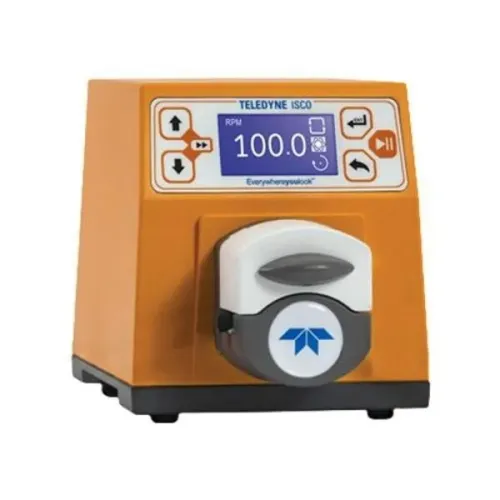
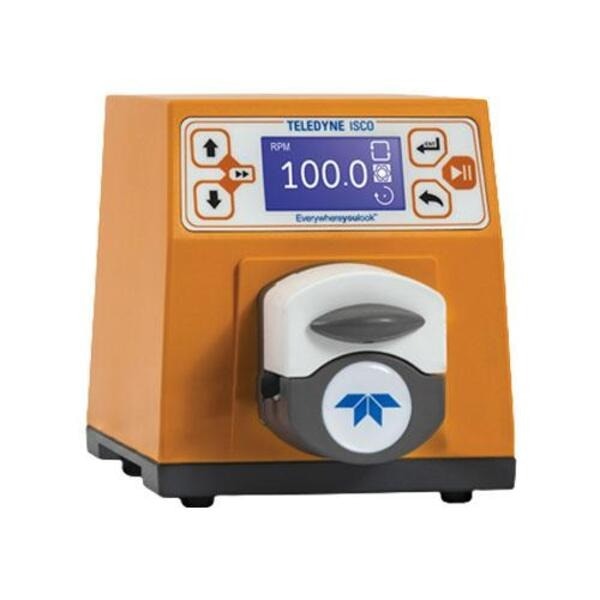
 | Pumps The Teledyne ISCO PeriXus Peristaltic Pump is designed for both laboratory use and continuous processing applications. View product → |
The operating workflow from tube loading to replacement
Load the chemically compatible tube into the PeriXus pump head, seat it evenly, and secure both connections before starting. This perixus pump setup must include the correct inlet and outlet orientation, an open source-vessel vent, compatible seals and filters, and a safe waste route. Keep the inlet short and unrestricted.
- Prime the inlet line before setting a controlled rate. Trapped air compresses and expands, causing delayed delivery, erratic fraction filling, and apparent flow error.
- While running, check steady tubing compression, connections, bubbles, vessel level, filter blockage, leakage, noise, and delivered flow. Stop immediately for a collapsed tube, slipping tube, open connection, loss of prime, or unexpected backpressure.
- Stop by reducing demand and preventing siphoning or uncontrolled draining. Do not leave the tube compressed longer than necessary.
- Reverse only at a controlled speed after confirming that the receiving and source vessels can accept reverse flow. Reversing against a closed valve can rupture tubing or eject fluid.
- Drain into a labelled waste vessel, then flush with a solvent compatible with the tube, seals, and residue. Use a final rinse that will not dilute or contaminate the next process.
- Clean the external pump head and fittings after isolating the fluid path. Flush or replace the wetted tube rather than trying to clean sample residue from the mechanism.
Check these conditions before resuming:
| Condition | Correct response | Immediate error to fix |
|---|---|---|
| Uneven flow | Reprime and inspect the inlet | Air entry or blocked filter |
| Leak at a fitting | Stop and reseat or replace the connection | Never continue leaking |
| Tube wear or flattening | Depressurise and replace it | Do not increase speed |
| Contamination risk | Flush or install new tubing | Do not pass the next sample |
Frequently asked questions
How does a PeriXus peristaltic pump move liquid from inlet to outlet?
The rotor rollers compress flexible tubing against the housing. Each occlusion traps liquid, and the rotating rotor carries that sealed volume toward the outlet.
How do you set up a PeriXus pump without disrupting the fluid path?
Connect the inlet tubing to the source, seat the tube evenly in the pump head, and route the outlet to the receiving vessel without kinks, sharp bends, or unintended connections.
How do you convert PeriXus pump speed into a verified flow rate?
Run the pump at the selected speed, collect the outlet liquid for a measured time, measure its volume, and calculate flow as volume divided by elapsed time.
How should you choose tubing for a PeriXus peristaltic pump?
Check the tubing against the fluid’s chemical compatibility, operating pressure, temperature range, internal diameter, wall thickness, and contamination-control requirements.
What is the correct PeriXus peristaltic pump workflow for loading and replacing tubing?
Stop and isolate the pump, remove the old tube, inspect the pump head, load the replacement evenly, secure the connections, prime the line, and verify flow before normal operation.