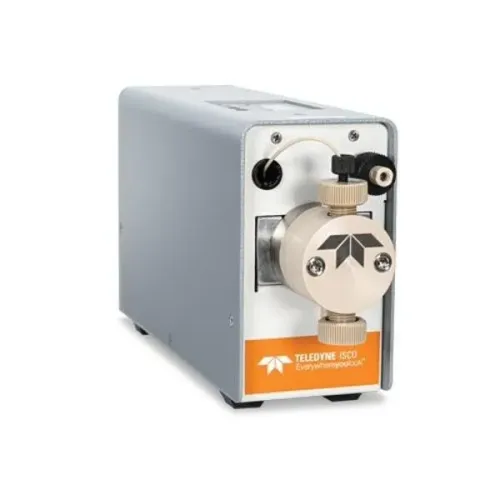

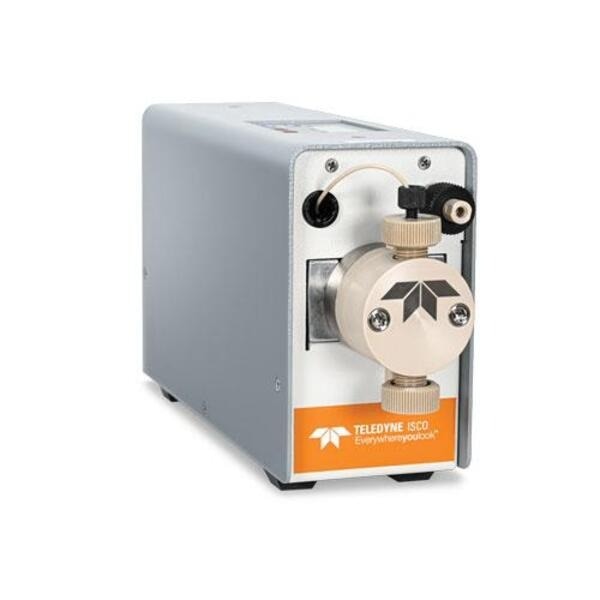
The right pump depends on more than a pressure rating or headline flow range. You need to match the pump to the separation, reaction, solvent, low-flow accuracy, pulsation tolerance, and safety rating of the complete fluid path before deciding whether it belongs in your laboratory.
Key takeaways
- Choose positive-displacement pumping when pressure and metering matter more than bulk transfer.
- Size the pump from actual flow, pressure, viscosity, and low-flow operating requirements.
- Treat pulsation as a method variable in chromatography, reactions, and detector measurements.
- Check every wetted material against the solvent, temperature, concentration, and cleaning cycle.
Which organic chemistry experiments justify a Reaxus reciprocating pump?
A Reaxus reciprocating pump fits an experiment when controlled, high-pressure liquid delivery matters more than moving bulk solvent quickly. The strongest case is positive-displacement metering against resistance, not general-purpose transfer.
| Task | Why the pump fits | Choose another design when |
|---|---|---|
| Preparative HPLC or column screening | Stable mobile-phase delivery against column backpressure supports repeatable separations and fraction collection | You only need gravity-fed flash solvent transfer |
| Sample loading or solvent exchange | Controlled volume and pressure limit overloading, channeling, and inconsistent displacement | Fast, low-pressure vessel filling is the only requirement |
| SFC-related delivery | Pressurized liquid delivery suits systems where solvent flow and pressure affect retention and separation | The system cannot rate the pump, fittings, and solvent conditions |
| Continuous-flow reaction dosing | Repeatable flow helps control reactor residence time, reagent ratio, and conversion | Abrasive slurry or unfiltered particulate feed is involved |
These are practical reaxus pump laboratory applications because flow stability determines whether each run is comparable. A high pressure laboratory reciprocating pump is valuable when a column needs consistent mobile phase, a reactor needs a defined residence time, or collected fractions must have repeatable volume.
Do not judge reaxus reciprocating pumps for organic chemistry labs by pressure rating alone. Confirm that the pump head, seals, valves, tubing, mixer, column or reactor, and safety relief path meet the method’s pressure and chemical requirements; simple solvent transfer, slurry movement, and low-pressure vessel feeding often suit another pump design better.
How do you size flow, pressure, and low-flow control for the method?
Size the pump from the method, not its headline maximum. For chromatography, record the column internal diameter, particle size, solvent viscosity, target linear velocity, and expected pressure drop; calculate flow from cross-sectional area and velocity, then check pressure at the thickest solvent and highest viscosity.
For flow synthesis, divide reactor volume by required residence time, then add loading, washing, and equilibration flows rather than sizing only the main run.
| Method element | Size or verify | Failure if ignored |
|---|---|---|
| Chromatography | Flow, pressure drop, viscosity, particle size | Slow separation or excessive backpressure |
| Flow synthesis | Reactor volume and residence time | Incorrect conversion or dosing ratio |
| Gradient | Composition accuracy, dwell volume, mixing volume, gradient delay | Correct displayed flow but wrong solvent composition |
A stated pump range does not prove accuracy at your chosen setpoint. Ask for accuracy and precision data at that flow, piston-stroke calibration details, adjustment resolution, ramping behaviour, and feedback method. Verify delivery by timed gravimetric or volumetric collection before quantitative dosing or preparative fraction collection.
At low flow, solvent compressibility, low inlet pressure, dissolved gas, poor degassing or priming, leaking check valves, and piston-seal leakage can turn a small absolute error into a large percentage error. Test the actual solvent and tubing.
Compare reaxus pump flow control by delivered volume and gradient composition, not the display alone. That evidence determines reaxus reciprocating pump value.
What does reciprocating pulsation change in a chromatography or reaction setup?
Each piston stroke can accelerate and slow the liquid, creating pressure ripple rather than perfectly steady flow. The impact depends on piston arrangement, flow rate, solvent compressibility, tubing volume, and detector position.
At a UV detector, ripple can appear as periodic signal noise. A refractive-index detector may show baseline movement instead. The column sees fluctuating pressure, a fraction collector can receive uneven volumes, and reaction dosing can vary in concentration or residence time.
These effects matter more in low-flow detection and quantitative dosing than in simple solvent delivery.
Reduce the disturbance with this plumbing checklist:
- Fit a correctly sized pulse dampener close to the pump outlet. It reduces pulsation; it does not guarantee elimination.
- Use short, appropriately pressure-rated tubing and secure every fitting.
- Install a pressure sensor and relief valve.
- Give the outlet suitable back pressure; an unrestricted outlet can worsen cycling.
During commissioning, record pressure and detector signal at the intended flow. Repeat the test with the dampener and the final column or reactor installed; reaxus pump flow control is a system result, not only a display value.
Document the maximum working pressure for the high pressure laboratory reciprocating pump system, including the column, injector, valves, sensors, fittings, tubing, and fraction collector. The lowest rating governs safe operation. A higher-rated pump cannot make a weaker downstream component safe.
Which solvents and fluid conditions create compatibility or reliability risks?
One pump-head material does not prove compatibility for Reaxus reciprocating pumps for organic chemistry labs. Verify the wetted pump head, piston seals, check-valve seats, tubing, fittings, inlet filter, pressure-sensor diaphragm, and any mixer as one fluid path.
| Fluid | Compatibility and reliability check |
|---|---|
| Acetonitrile | Check seals, plastics, and sensor diaphragm; inspect for swelling or leaks. |
| Methanol | Confirm elastomer compatibility and flushing requirements. |
| Tetrahydrofuran | Demand documented seal, tubing, and fitting compatibility; test before continuous use. |
| Dichloromethane | Check plastics, seals, and fittings for softening or permeation. |
| Ethyl acetate | Verify seals and tubing, especially at elevated temperature. |
| Hexane | Check elastomers and tubing for swelling, shrinkage, or leakage. |
| Dimethyl sulfoxide | Confirm materials tolerate its high solvency and viscosity. |
| Aqueous buffers | Check corrosion resistance, salt crystallisation, and storage practice. |
| Concentrated acids, bases, and oxidants | Require chemical-specific materials review and application testing; do not infer compatibility from water. |
| Moisture-sensitive reagents | Keep the path dry, sealed, and compatible with the reagent and quench procedure. |
Suspensions and crystallising solutes damage valve seats or clog inlet filters. Viscous solutions increase pressure drop and slow check-valve response. Use filtration and application testing for particulate feeds.
Use degassed solvent, a short leak-free inlet, adequate solvent head, or controlled inlet pressure. Dissolved-gas release and volatile-solvent evaporation cause cavitation, loss of prime, and pressure oscillation.
Flush mixtures that change viscosity during a run, clean the wetted path promptly, and store it in the specified compatible solvent; these practices matter in Reaxus pump laboratory applications.
How should you judge Reaxus reciprocating pump value before purchase?
A low purchase price does not establish ReaXus reciprocating pump value. Count the solvent wasted during failed priming, contaminated columns, lost fractions, cleaning time, replacement parts, downtime, and the cost of obtaining local service.
Ask the supplier for:
- The exact pump-head configuration, complete wetted-material list, seal and check-valve options, intended-flow accuracy and precision data, pressure limits at that flow and solvent, calibration procedure, pulse-dampener requirements, and service intervals.
Request a demonstration or acceptance test with the actual solvent, tubing dimensions, back pressure, column or reactor, and low-flow setpoint. Verify collected volume gravimetrically or volumetrically; a displayed setpoint does not prove delivered flow.
| Cost item | What to count | Why it changes the decision |
|---|---|---|
| Solvent and samples | Failed priming, flushing, contaminated columns, lost fractions | Low-flow errors become expensive quickly |
| Consumables | Piston seals, check valves, inlet filters | Wear causes leakage, ripple, or loss of prime |
| Lab time | Cleaning, troubleshooting, recalibration, downtime | Uptime can outweigh purchase-price savings |
| Service | Response time, parts availability, local access | A failure can halt a separation or reaction |
Septech Marketing LLP can help compare a ReaXus configuration with your separation or reaction setup instead of treating ReaXus reciprocating pumps for organic chemistry labs as universal equipment.
Choose it when verified flow stability, pressure capability, and maintainability solve a defined laboratory problem; choose another design for bulk transfer, abrasive slurry handling, or an untested reactive-fluid application.
Related products
 | Pumps The Teledyne ISCO ReaXus Series offers a versatile range of reciprocating pumps designed to meet a wide variety of laboratory and industrial needs. View product → |
 | Pumps Septech introduces a new class of reciprocating pumps designed to deliver liquid CO₂ for supercritical fluid extraction (SFE), supercritical fluid... View product → |
Frequently asked questions
Which organic chemistry experiments justify a Reaxus reciprocating pump?
Use one when an experiment needs controlled liquid delivery against significant resistance, such as high-pressure chromatography, reagent metering, or solvent delivery. Choose a transfer pump for moving bulk solvent without precise pressure control.
How do you size flow, pressure, and low-flow control for the method?
Start with the method’s required flow range, maximum operating pressure, solvent viscosity, tubing size, and acceptable flow error. Confirm that the pump can regulate the lowest required flow without unstable cycling, then include pressure margin without oversizing the pump.
What does reciprocating pulsation change in a chromatography or reaction setup?
Reciprocating motion creates periodic flow variation unless the system reduces it. Pulsation can affect detector baselines, retention-time consistency, mixing, residence time, and reaction dosing, so assess damping, pulse frequency, and downstream volume.
Which solvents and fluid conditions create compatibility or reliability risks?
Check wetted seals, valves, heads, tubing, and fittings against each solvent, concentration, temperature, and cleaning fluid. Pay special attention to aggressive solvents, particles, crystallising mixtures, high viscosity, gas entrainment, and solvent combinations that swell seals or damage materials.
How should you judge Reaxus reciprocating pump value before purchase?
Compare useful operating range rather than maximum pressure alone. Include low-flow stability, pulsation control, solvent compatibility, maintenance access, validation records, spare parts, cleaning time, and the cost of redesigning the method around an unsuitable pump.