
A fraction collector cannot act on a mass signal at the instant the mass spectrometer sees it: the monitored split stream arrives first, while the main chromatographic stream is still travelling toward the collection valve. By the end, you will be able to map m/z and retention time to collection timing, set trigger rules, manage ionisation problems, and verify that each selected fraction contains the intended compound.
Key takeaways
- Split-flow detection links the MS signal to the correct fraction vessel.
- Set ion criteria, retention timing, and collection delay before injection.
- Flush and control carryover before collecting the next fraction.
- Verify the target compound in the collected fraction with a second analysis.
From injection to fraction: how the PurIon workflow links the MS signal to a vessel
The MS does not identify the liquid inside a vessel. It detects a small stream after the column, while the main stream continues toward the fraction collector.
- The dissolved sample is injected into the LC, where the column separates compounds by retention time.
- A post-column splitter sends an analytical portion to the ion source and keeps the preparative stream moving toward collection.
- The source ionises eluting molecules, producing charged species such as [M+H]+ or [M-H]−.
- The mass analyser filters or scans by mass-to-charge ratio (m/z), and the detector records signal intensity against time.
- Software tests the signal against the selected ion, mass tolerance, intensity threshold, and retention-time rules.
- A qualifying event triggers collection after the programmed delay, directing the matching eluent into a numbered tube, well, or vessel.
The PurIon mass spectrometer workflow therefore links three records: retention time, detected m/z, and the collector’s fraction number. The practical question, how purion mass spectrometer for tracks compounds through fractionation, has a timing answer: the system predicts when material seen by the MS will reach the valve.
That delay must account for post-column tubing volume, flow rate, splitter geometry, and MS response time. If it is wrong, a strong peak can enter the wrong vessel. Short windows limit dilution but can divide one peak; long windows improve recovery while collecting more neighbouring impurity.
The configured split ratio also controls MS sensitivity and the solvent volume reaching collection.
Set the target ion, timing rules, and collection delay before the run
Set the target m/z, expected adduct, tolerance, scan range, and trigger rules before injecting the sample. A method that accepts every ion in a broad range can collect chemical noise; a narrow method can miss the compound when ionisation produces a different adduct.
| Parameter | What to set | What goes wrong if mis-set |
|---|---|---|
| Target m/z and adduct | Enter the ion actually expected, such as [M+H]+, [M+Na]+, or [M-H]− | The compound elutes but never triggers collection |
| Mass tolerance | Define the allowed distance from the target, in daltons or ppm | A tolerance that is too wide admits unrelated ions; one that is too narrow rejects mass drift |
| Scan range | Include the target and its likely adducts, without unnecessary mass space | The target falls outside the acquired spectrum |
| Solvent delay | Suppress MS triggering during the post-injection solvent front | Background or solvent ions start a false fraction |
| Intensity threshold | Set the minimum signal for collection | Too low collects noise; too high misses weak or suppressed peaks |
| Retention-time window | Limit triggering to the expected elution interval | Carryover or unrelated peaks activate collection |
| Fraction boundaries | Define start and stop rules around the chromatographic peak | Early or late eluent enters the wrong vessel |
| Collector delay | Enter the measured MS-to-collector travel time | The correct signal is assigned to the wrong fraction |
For purion mass directed fractionation, remember that the MS sees a post-column split, not the entire preparative stream. Confirm the split ratio, then calibrate the collection delay with the actual flow path before relying on fraction numbers.
Operate the system without losing the signal or contaminating later fractions
Prepare mobile phase with the specified grade, additives, filtration, and degassing method. Check solvent levels, caps, inlet filters, waste capacity, and waste-line placement before connecting the system.
- Inspect the column outlet, splitter, transfer tubing, collection line, injector, and probe for kinks, loose fittings, salt deposits, or trapped bubbles.
- Check the ion source and spray interface for contamination. Clean only with the procedure and solvents specified in the PurIon operating manual.
- Confirm gas, vacuum, polarity, source settings, calibration or tuning status, scan range, and target-ion settings before the sample run.
- Prime each solvent and sample path until flow is bubble-free, then perform the manual’s leak check at the intended preparative flow rate.
- Load the dissolved sample without exceeding the injector or column limit. Record the column, tubing, splitter ratio, flow rate, and solvent composition.
- Monitor pressure, spray stability, baseline, target-ion response, and fraction events. Stop if pressure rises, the spray destabilises, or the signal appears before the expected delay.
- After collection, stop the sample flow, flush the column, splitter, probe, and collection path with the validated wash, then complete the manual’s shutdown sequence.
| Check | Why it matters | Confirm before use |
|---|---|---|
| Delay time | Wrong plumbing moves a peak into the wrong vessel | Recheck after any tubing, splitter, flow-rate, or solvent change |
| Source background | Carryover creates false triggers | Run a blank and inspect inter-run background |
| Collection window | Short windows split peaks; long windows collect impurities | Compare boundaries with the chromatogram |
Septech Marketing LLP can help match the PurIon setup to preparative plumbing, but the operating manual controls instrument-specific limits and procedures.
Related product
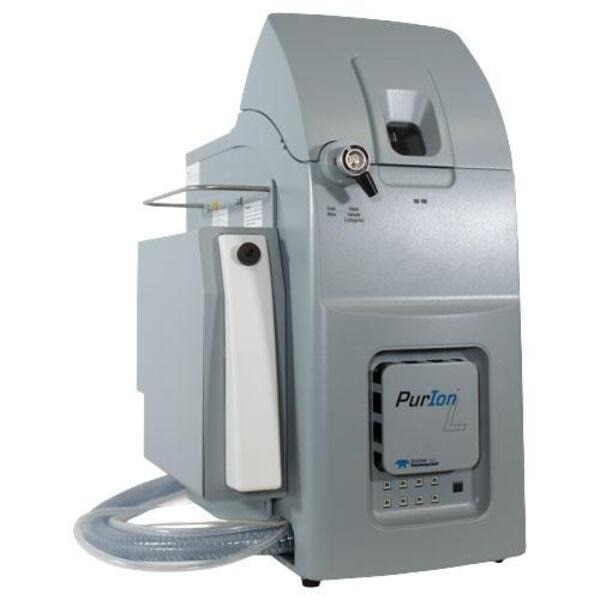
 | Chromatography The PurIon™ Mass Spectrometer is a compact, affordable, single-quadrupole mass analyzer designed for mass-directed fractionation in flash and... View product → |
Handle weak ions, unexpected retention times, adducts, and overlapping compounds
A target outside the configured scan range cannot trigger collection. Extend the m/z range or add the expected ion explicitly, then reacquire a standard before injecting valuable material.
If the signal is weak, inspect spray stability, source cleanliness, sample concentration, matrix suppression, and the intensity threshold; lowering the threshold can recover a suppressed peak, but also collects chemical noise.
- For [M+H]+, use the protonated mass as the target; for [M+Na]+, add the sodium adduct as a separate target; for [M-H]−, switch to negative-ion operation and set the deprotonated mass.
- If the source fragments the compound, reduce source or collision energy and target the intact ion. Use a fragment only when its identity and collection behaviour have been confirmed.
- If retention time shifts, check flow, gradient composition, column condition, temperature, and equilibration before widening the retention-time window. Re-measure the MS-to-collector delay; a correct peak with the wrong delay enters the wrong vessel.
- If the peak is weak, lower the threshold only after checking blanks and background. A high threshold misses suppressed material, while a low threshold fills fractions with noise.
The Purion compound analysis process must treat one m/z as evidence, not identity. Isobars, isotope peaks, adducts, and coeluting compounds can share that signal; change the chromatographic method when possible, or collect narrower timed fractions and confirm them by reinjection, a second LC-MS method, or another orthogonal test.
Confirm that the collected fraction contains the intended compound
A trigger proves only that the split stream produced a signal at a recorded time. It does not prove that the collection vessel contains the intended compound, because the vessel receives the larger stream after a delay.
- Extracted-ion traces show whether the target ion appears as one clean peak or overlaps another ion. A shared m/z can represent an isobar, isotope peak, or different adduct, so it does not establish identity.
- UV data can expose co-elution that the selected ion hides. A broad or shouldered UV peak alongside a narrow mass trace warrants purity testing.
- Reinjection of each selected fraction checks target presence, recovery, and retention time. A target appearing in the adjacent vessel points to an incorrect collection delay or boundary.
- Blank runs after a strong sample reveal carryover from the injector, column, transfer line, splitter, or source. Background near the trigger threshold can create false collections.
- Post-run mass checks of the complete run can show late target signal, unexpected adducts, or a suppressed peak that the live threshold missed. A UV peak with weak extracted-ion response indicates ion suppression.
- Fraction testing by a second LC-MS method, UV assay, or another validated method confirms purity and detects a coeluting isobar.
In the PurIon compound analysis process, compare fraction results with both streams’ timestamps and the configured split ratio. A mismatch means the MS saw one chromatographic band while the collector received another. PurIon mass-directed fractionation is therefore a routing system, not an identity test.
Frequently asked questions
How does the PurIon workflow link an MS signal to a fraction vessel?
The mass spectrometer monitors a small post-column stream while the main stream continues to the fraction collector. The control system uses the detected ion, retention timing, and collection delay to direct the target peak into a vessel.
What settings must you define before a PurIon fractionation run?
Define the target ion or mass-to-charge value, the detection threshold, the start and stop timing rules, and the delay between detection and arrival at the collection vessel.
How do you prevent signal loss and contamination between fractions?
Check solvent flow, spray stability, tubing connections, vessel positioning, and the collection delay before starting. Flush the flow path and confirm that the next vessel is selected before collecting another peak.
What should you do when ions are weak, retention times shift, or compounds overlap?
Confirm spray and solvent conditions for weak ions, widen the timing window when retention shifts, inspect adducts such as sodium or ammonium species, and use separate ion criteria or narrower windows for overlapping compounds.
How do you confirm that a collected fraction contains the intended compound?
Reanalyse an aliquot of the fraction and compare its detected ion, retention time, and supporting spectral evidence with the target compound recorded during the separation.