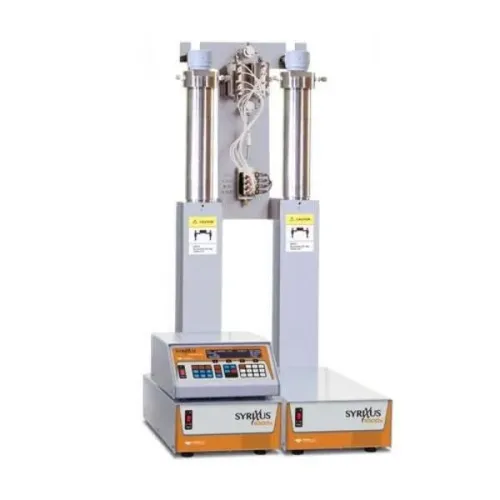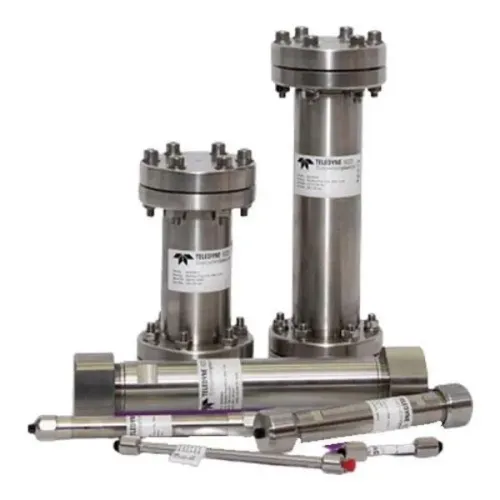

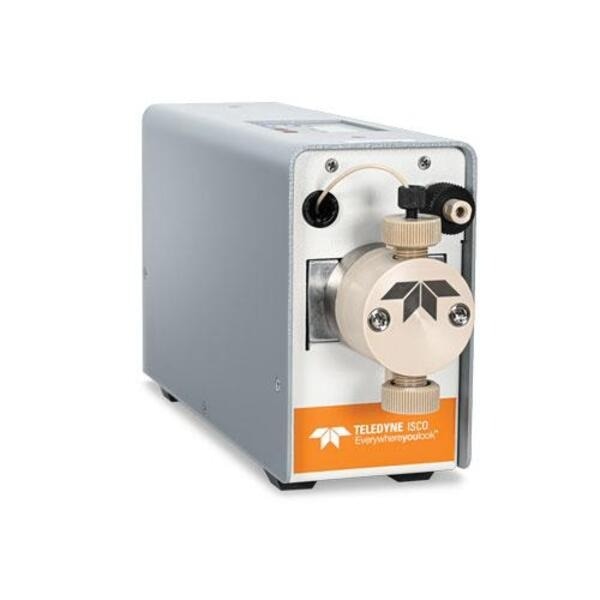
A pump that reaches high pressure is not automatically a good choice for assay, impurity, or method-development work. You will be able to match the exact ReaXus model to your flow, pressure, solvent, maintenance, qualification, and local-service requirements before accepting a quotation.
Key takeaways
- Choose ReaXus for controlled, high-pressure chromatography flows—not routine solvent transfer.
- Match pump pressure and flow ranges to your method’s actual operating window.
- Demand pulsation, leak, flow-accuracy and pressure-hold acceptance data before purchase.
- Budget for calibration, spares, service access and Mumbai operating conditions.
Which Mumbai QC workflows justify a ReaXus reciprocating pump?
A ReaXus pump earns its place when your QC method pushes solvent through a packed column at high pressure and low, controlled flow. That points to analytical HPLC, semi-preparative chromatography, SFC, SFE, column testing, and method development—not routine bottle transfer or low-pressure preparative work.
Are ReaXus reciprocating pumps worth it for quality control labs in Mumbai? Yes, when pressure capability directly protects throughput, resolution, or method transfer.
| Workflow | Why a reciprocating pump helps | Practical verdict |
|---|---|---|
| Analytical HPLC | Drives packed columns at high pressure and low flow | Strong fit |
| Semi-preparative HPLC | Supplies pressure during purification and scale-up checks | Fit when pressure demand is real |
| SFC or SFE | Handles demanding solvent delivery and pressure control | Fit after testing actual solvents |
| Column testing and method development | Reveals pressure, flow, and stability limits | Fit for active development labs |
| Low-pressure transfer or simple dosing | Does not use the pump’s high-pressure advantage | Usually poor value |
The ReaXus pump benefits for analytical laboratories come with work. Piston motion leaves residual pulsation, while air bubbles and outgassing can cause pressure fluctuation, retention-time drift, or failed runs. Test the intended aqueous-organic mixtures, volatile solvents, tubing layout, degasser, and Mumbai laboratory temperature—not only degassed water.
A 6010 or 7010 also demands maintenance planning. If your lab needs unattended operation, has uncertain local service, or cannot stock piston seals and check valves, a simpler pump can cost less in downtime even when its pressure rating is lower.
Do the ReaXus flow and pressure ratings fit your actual method?
A 10 mL/min maximum does not prove that a pump suits your method. Match the actual flow, pressure, mobile phase, and run duration against the configured pump head, not the headline rating. The ReaXus 6010 is commonly specified to about 10 mL/min and 400 bar; the 7010 reaches about 700 bar.
Exact limits depend on pump-head and seal materials and operating conditions.
| Model | Approximate pressure limit | Practical fit |
|---|---|---|
| ReaXus 6010 | Up to 400 bar | Routine analytical HPLC within that pressure range |
| ReaXus 7010 | Up to 700 bar | Higher-pressure methods, subject to configured head and seals |
For low-flow analytical work, request accuracy and precision data at 0.2–2.0 mL/min. Do not infer performance at those flows from a 10 mL/min rating. Include pulsation, priming, and pressure stability data with your actual solvent mixture; bubbles and outgassing can make a pump that behaves well with degassed water unstable with aqueous-organic mobile phases.
Use these steps before accepting a quotation:
- State the method flow range, maximum backpressure, solvent composition, temperature, and longest continuous run.
- Ask for ReaXus reciprocating pump specifications at your operating point, plus the exact 6010 or 7010 configuration.
- Choose a pump whose normal operating point sits below its maximum pressure and flow, leaving headroom for column ageing, filters, and viscosity changes.
- Test ReaXus reciprocating pumps for quality control with your tubing, degasser, bottles, and mobile phases before purchase.
How does a reciprocating pump compare with other QC pump types?
High pressure at low flow is the reciprocating pump’s advantage: it drives solvent through packed analytical columns without needing the larger flow capacity of preparative equipment. The reaxus pump benefits for analytical laboratories appear when retention-time stability, gradient delivery, and pressure capability matter more than zero-maintenance operation.
| Pump type | Main strength | QC trade-off |
|---|---|---|
| Reciprocating piston | High pressure at low analytical flow | Piston pulsation, air sensitivity, seal and check-valve maintenance |
| Peristaltic | Simple tubing-based fluid handling | Lower pressure, tubing wear, flow variation, and limited solvent compatibility |
| Syringe or piston | Very smooth, accurate delivery | Finite stroke volume, refill interruption, and slower high-volume operation |
| Diaphragm | Robust transfer and solvent handling | Pulsation, lower analytical precision, and less suitability for demanding gradients |
| Other HPLC pump | Established dual-piston control and accessories | Performance depends on degassing, seals, valves, and service support |
For reaxus reciprocating pumps for quality control, check the complete solvent list rather than the headline pressure rating. Acetonitrile, methanol, alcohols, acidic additives, phosphate buffers, and cleaning solvents can affect stainless-steel, ceramic, PEEK, tubing, and seal choices differently.
Degas every mobile phase and test the actual bottle-to-pump tubing layout; outgassing in a warm Mumbai laboratory can create bubbles, pressure ripple, baseline noise, and retention-time shifts. Do not let phosphate buffers dry in the head, inlet frit, check valves, or seal area.
Flush with a compatible solvent after use, because that routine often determines uptime more than a modest pressure difference.
Which specifications and acceptance tests should you demand?
Demand a configuration-specific specification and a real-method acceptance test, not a brochure. The ReaXus reciprocating pump specifications must identify the exact 6010 or 7010 model, configured pump head, flow range, pressure rating, wetted materials, seals, controls, and pressure-monitoring method.
The 6010 is commonly rated to about 10 mL/min and 400 bar; the 7010 reaches about 700 bar, subject to pump-head and operating conditions.
Your purchase checklist should include:
- Flow accuracy and repeatability at the method flow, not only at maximum output.
- Pulsation or pressure-ripple limits, with the measurement location and sampling rate stated.
- Wetted materials, piston and seal materials, solvent compatibility, and replacement intervals.
- Priming, purge, degassing, check-valve, shutdown, and restart functions.
- Pressure transducer range, alarm limits, overpressure response, and data output.
- Operating manual, wiring information, factory test report, serial-number traceability, and calibration or qualification evidence for the supplied unit.
Run acceptance testing with your actual column and mobile phase.
| Test | Record | Reject if |
|---|---|---|
| Prime and purge | Time, trapped air, leaks | Priming fails or connections weep |
| Method flow | Measured flow at low, nominal, and high method rates | Accuracy or repeatability misses your written limit |
| Pressure stability | Ripple, alarms, and leak tightness | Ripple affects baseline or pressure drifts |
| Chromatographic run | Retention time, peak area, and recovery after overnight shutdown | Results fail method precision or restart is unreliable |
Water testing at maximum flow proves little; solvent viscosity, seals, check valves, and degassing determine routine QC performance.
What should Mumbai ownership cost beyond the pump quotation?
A low pump quotation is not the ownership cost. Compare the delivered cost of the pump, degasser or mixer requirements, spare seal and check-valve kits, preventive maintenance, IQ/OQ, calibration, and the cost of downtime while a pump-head or seal kit is imported. Ask a reaxus pump supplier in mumbai for these figures before comparing offers.
- Name the exact 6010 or 7010 model, pump-head and seal materials, flow range, installation responsibility, and IQ/OQ documents.
- Record the breakdown response time, escalation route to the manufacturer, local stock of piston seals and check valves, calibration support, and preventive-maintenance interval.
- Test the supplied unit with your actual mobile phases, solvent bottles, tubing layout, degasser, and room temperature. Air bubbles and solvent outgassing can make a pump pass with degassed water but fail with an aqueous-organic method.
- Confirm 230 V, 50 Hz operation, permissible voltage variation, laboratory temperature and humidity limits, ventilation, and protection from unstable mains power.
- Price lost batches, analyst time, method reruns, and standby equipment during imported-parts delays. Add those costs to the quotation.
Septech Marketing LLP can be included in the comparison only after its offer states who installs, qualifies, services, and supplies local spares.
That evidence helps answer are reaxus reciprocating pumps worth it for quality control labs in mumbai: the pump earns its place when high-pressure analytical work justifies maintenance, not when unattended, low-maintenance operation matters more than pressure capability.
Related product
Frequently asked questions
Which Mumbai QC workflows justify a ReaXus reciprocating pump?
Analytical HPLC, semi-preparative chromatography, SFC, SFE, column testing and method development justify it when the method needs controlled solvent flow through a packed column at high pressure. Routine bottle transfer and low-pressure preparative work do not.
Do ReaXus flow and pressure ratings fit your actual method?
Compare the pump’s specified flow range and maximum pressure with your method’s normal flow, solvent viscosity, column backpressure and safety margin. Size the pump for the operating point, not only the headline maximum rating.
How does a reciprocating pump compare with other QC pump types?
A reciprocating pump suits precise, high-pressure chromatography delivery. Diaphragm, peristaltic and gear pumps may be better for transfer, metering or solvent handling when pressure, pulsation and flow stability demands differ.
Which specifications and acceptance tests should you demand?
Request the pump head materials, wetted-path compatibility, flow range, pressure rating, pulsation data, leak performance, control resolution and calibration method. Test delivered flow, pressure hold, leakage, pulsation and operation across your method’s solvent range.
What should Mumbai ownership cost beyond the pump quotation?
Include installation, commissioning, calibration, preventive maintenance, seals, check valves, filters, tubing, solvent compatibility checks, technician travel, response time and downtime during service.
Related product
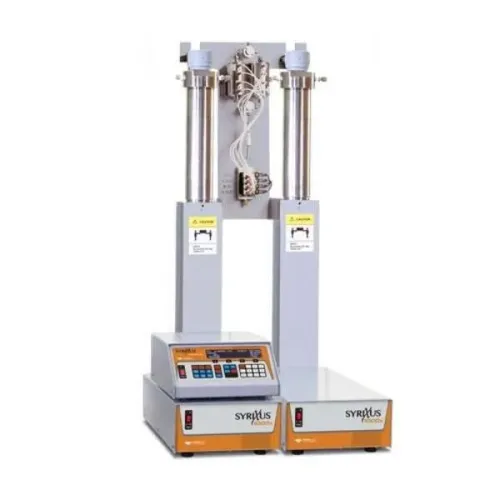
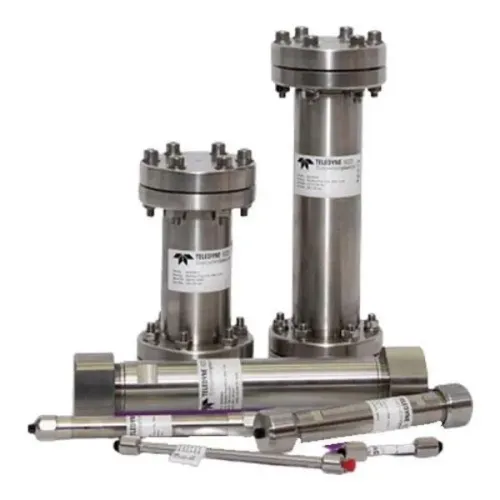
 | Pumps The Teledyne ISCO ReaXus Series offers a versatile range of reciprocating pumps designed to meet a wide variety of laboratory and industrial needs. View product → |