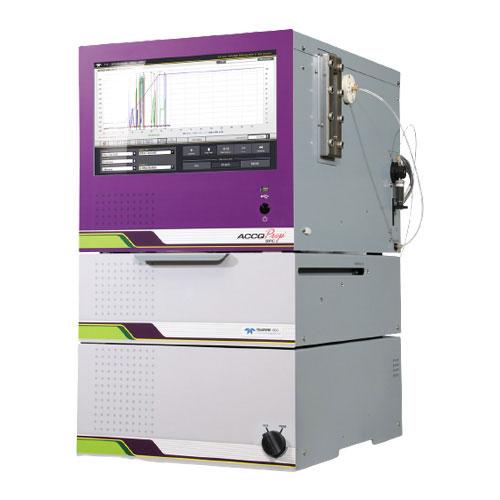
Supercritical Fluid Chromatography (SFC) is an advanced separation technique that uses a supercritical fluid—most commonly carbon dioxide (CO₂)—as the mobile phase. In its supercritical state, CO₂ exhibits properties of both a gas (low viscosity, high diffusivity) and a liquid (solvation strength), enabling fast, efficient, and high-resolution separations. SFC bridges the gap between gas chromatography (GC) and liquid chromatography (LC), offering the speed of GC with the versatility of LC. How SFC Works When CO₂ is brought above its critical temperature and pressure, it becomes a supercritical fluid. In this state, it: Penetrates stationary phases efficiently (like a gas) How SFC Works When CO₂ is brought above its critical temperature and pressure, it becomes a supercritical fluid. In this state, it: *Penetrates stationary phases efficiently (like a gas) *Dissolves analytes effectively (like a liquid) *Enables rapid mass transfer and shorter run times Modifiers such as methanol or ethanol are often added to enhance solubility for polar compounds. Dissolves analytes effectively (like a liquid) Enables rapid mass transfer and shorter run times Modifiers such as methanol or ethanol are often added to enhance solubility for polar compounds. Key Components of an SFC System An SFC system typically includes: *Pump – Delivers liquid CO₂ and organic modifiers at precise flow rates *Injector – Introduces the sample into the mobile phase *Column oven – Maintains controlled temperature for reproducibility *Chromatographic column – Packed with stationary phase for separation *Detector – Commonly UV, PDA, MS, or ELSD for compound detection *Back Pressure Regulator (BPR) – Maintains pressure to keep CO₂ in its supercritical state Advantages of SFC: ✔ Faster separations compared to traditional HPLC ✔ High efficiency and sharp peak resolution ✔ Reduced solvent consumption (greener technology) ✔ Easy solvent removal due to volatile CO₂ ✔ Ideal for chiral separations ✔ Compatible with mass spectrometry detection Applications of SFC :SFC is widely used in: *Pharmaceutical analysis – Chiral drug separation, impurity profiling *Environmental testing – Pesticides and pollutant analysis *Natural products research – Plant extracts and bioactive compounds *Chemical research & synthesis labs – Reaction monitoring and purification Why SFC is Growing in Popularity Supercritical Fluid Chromatography offers a powerful alternative to traditional HPLC by providing: *Higher throughput *Improved selectivity *Lower operational costs *Environmentally friendly workflows As laboratories increasingly prioritize speed, sustainability, and analytical performance, SFC continues to gain adoption in both analytical and preparative-scale applications.

Mumbai
08048041145
+919821412924
 Chat with us
 Chat with us